Barry, OppHub America Desk · · Source: yahoo-big4-etfs
Buffer ETFs Offer Downside Protection Amid Market Pullback
Investors seeking to limit downside exposure during periods of market uncertainty may find value in buffer ETFs. Products like offer a full 100% downside buffer, though this comes at the cost of capped upside potential, as seen in its 4% year-to-date return compared to the 's 13% gain.
Based on reporting from yahoo-big4-etfs.
Stocks saw broad declines on August 14, 2026, prompting renewed interest in buffer exchange-traded funds that offer downside protection. These ETFs aim to mitigate losses in exchange for capped upside, a trade-off becoming more attractive as market volatility persists. MAXJ provides 100% downside protection, though with significant return limitations.
Market context for this story
As of: After HoursLoading quotes…
Informational only — not investment advice. Full markets →


$SPYSPDR S&P 500 ETF
TradingView
Live chart & market data via TradingView · OppHub classroom · Delayed or exchange real-time per TradingView data agreements · Not investment advice
$QQQInvesco QQQ Trust
TradingView
Live chart & market data via TradingView · OppHub classroom · Delayed or exchange real-time per TradingView data agreements · Not investment advice
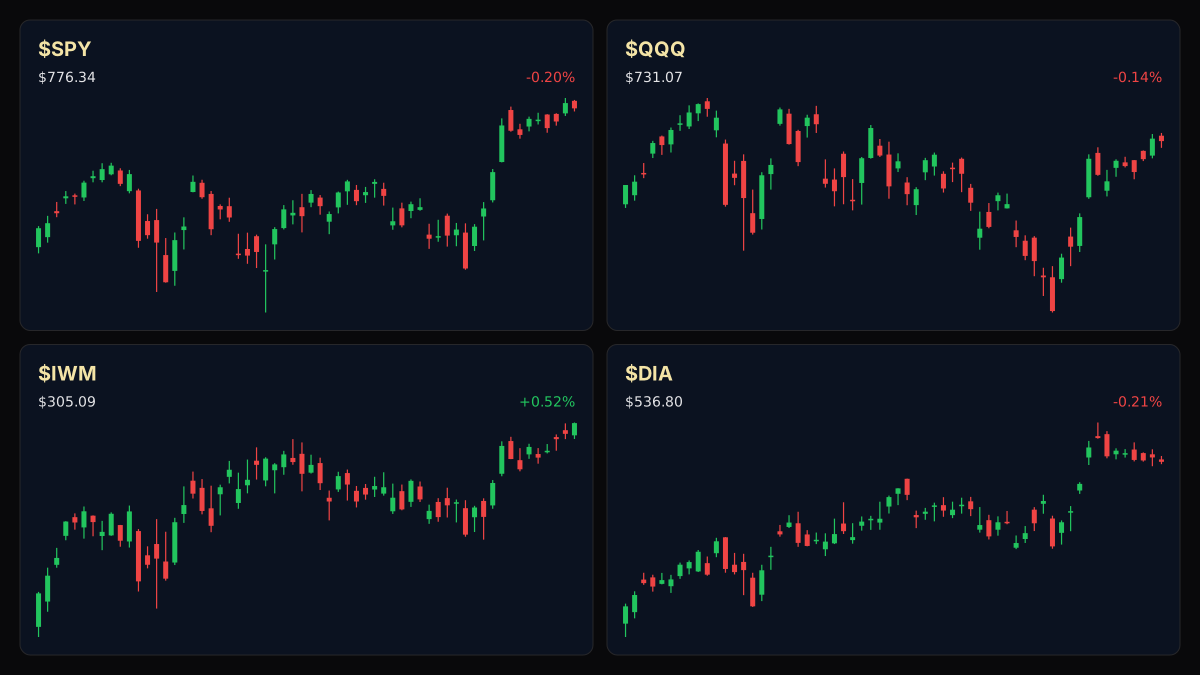
Educational TradingView charts — search any symbol in the widget. Confirm on /markets/SPY and related $QQQ, $DIA, $IWM. Not investment advice.
Related markets
Shares a vertical MP4 loop to your phone's camera roll or app share sheet (Instagram, TikTok, Facebook Reels).
Major indices experienced declines on August 14, 2026, with the S&P 500 falling 0.29%, the Dow Jones Industrial Average down 0.31%, and the Nasdaq 100 shedding 0.22%. The Russell 2000 bucked the trend, gaining 0.35%. This pullback has heightened investor focus on strategies offering downside protection, particularly buffer ETFs.
Products like the iShares Large Cap Max Buffer Jun ETF (MAXJ) are designed to provide a full 100% downside buffer over their outcome windows, albeit with capped upside potential. Year-to-date, MAXJ has returned approximately 4%, compared to the SPDR S&P 500 ETF Trust ($SPY+WL) which has gained 13%. This illustrates the trade-off: investors forego a significant portion of potential gains for the promise of limited losses.
Other buffer ETFs, such as the Innovator U.S. Equity Power Buffer ETF August (PAUG) and the FT Vest Laddered Buffer ETF (BUFR), offer partial downside protection of around 15% and 10%, respectively. The current market environment, with the VIX near 12-month lows and the $SPY+WL up 13% year-to-date, makes options-based protection strategies relatively more affordable. MAXJ, the smallest of the three funds discussed, has a 0.50% expense ratio and a beta of 0.30.
Read the full story
Original reporting and related coverage — attribution links only, not paid recommendations.
Trade this story
 Robinhood
 Webull
 Tradier
 IBKR
IBKR
Chart this story
 TradingView
Broker and exchange buttons use invite / refer-a-friend links (rewards may be capped). Charting links (TradingView) are partner offers that may pay OppHub America a commission at no extra cost to you.
OppSHOP
Full OppSHOP →As an Amazon Associate, OppHub America earns from qualifying purchases. Shopping here helps keep the site free — at no extra cost to you. Disclosure

OppSHOP
Related to this story
Investors seeking to limit downside exposure during periods of market un
Shop related →

Investing books
Read the classics
Shop this pick →

Personal finance books
Run the household books
Shop this pick →

Trading notebooks
Write the thesis first
Shop this pick →

Monitor for charts
See every pane
Shop this pick →
Story playbook
A pre-built map of what to watch — stocks, ETFs, and educational next steps. Not personalized advice.
Snapshot date: August 14, 2026 at 8:56 PM ET
This playbook was built when the story published and is not live-updated. Prices, news, and risk can change after this date — treat it as a starting map, not a current trade ticket.
Story → money map
Buffer ETFs and Downside Protection
The stock market dipped slightly, causing investors to look for special funds that promise to protect them from losing money. These protective funds limit how much you can lose, but they also limit how much money you can make.
What changed
A broad-market pullback on August 14, 2026, sparked increased demand for downside-protected buffer ETFs.
Who wins / who loses
Providers of buffer and defined-outcome ETFs benefit from defensive demand, while investors accepting capped upside forego broader market gains.
Time horizon
Think in terms of the next few months.
Confidence & best fit
high confidence · Long-term investor
Safer theme exposure (ETFs)
Baskets that own the theme without betting on one company.
Single stocks (higher risk)
Primary = closest to the story · Peers = same industry · Second-order = knock-on effects · Avoid = looks related but may be a trap
Primary
- $MAXJBuild slowly — only if it fits your plan
This special fund tries to stop you from losing any money if the market drops, but it keeps your maximum profits lower.
Peer
- $PAUGWatch — track, don’t rush
Another protective fund that shields you from the first 15% of market drops.
- $BUFRWatch — track, don’t rush
A fund that provides a smaller safety net against falling stock prices.
Options (education only)
No strikes or expiries — a framework for how traders might express the view. Options can expire worthless.
Direction: volatile · Style: Protective put / downside hedge idea · Level: intermediate
Buying insurance contracts on the stock market can protect you if prices fall, but beginners should stick to standard funds instead of complex options.
Income / OppHub America angle
Not a trade tip — ways to use the insight outside the market.
- Review existing portfolio allocation to determine if downside protection aligns with personal risk tolerance.
What would break this thesis
- A rapid resumption of strong upward market momentum making capped gains unappealing.
What to do next on OppHub America
Saved playbooks stay on this device for now.
Important
Not financial advice. OppHub America playbooks are educational market maps only — not recommendations to buy, sell, or hold any security. Markets move fast; information can be wrong or outdated. Trade and invest at your own risk. Do your own research or consult a licensed advisor.
Based on reporting from yahoo-big4-etfs.
Informational and educational only — not investment, financial, or legal advice. Disclosure
Shares a vertical MP4 loop to your phone's camera roll or app share sheet (Instagram, TikTok, Facebook Reels).