Barry, OppHub America Desk · · Source: yahoo-tickers-tape-movers
Cloud Infrastructure 2027: Oracle Growth vs. AWS Scale
Cloud infrastructure spending impacts enterprise hardware suppliers and hyperscale cash flow sustainability.
Based on reporting from yahoo-tickers-tape-movers.
Oracle Cloud Infrastructure surged 121% to $7.388 billion while Amazon Web Services posted $42.232 billion, highlighting a high-stakes datacenter race for 2027 capacity. Traders and cloud infrastructure investors are weighing Oracle's aggressive capital expenditure plans against established enterprise scale.
Market context for this story
As of: PremarketLoading quotes…
Informational only — not investment advice. Full markets →


$SPYSPDR S&P 500 ETF
TradingView
Live chart & market data via TradingView · OppHub classroom · Delayed or exchange real-time per TradingView data agreements · Not investment advice
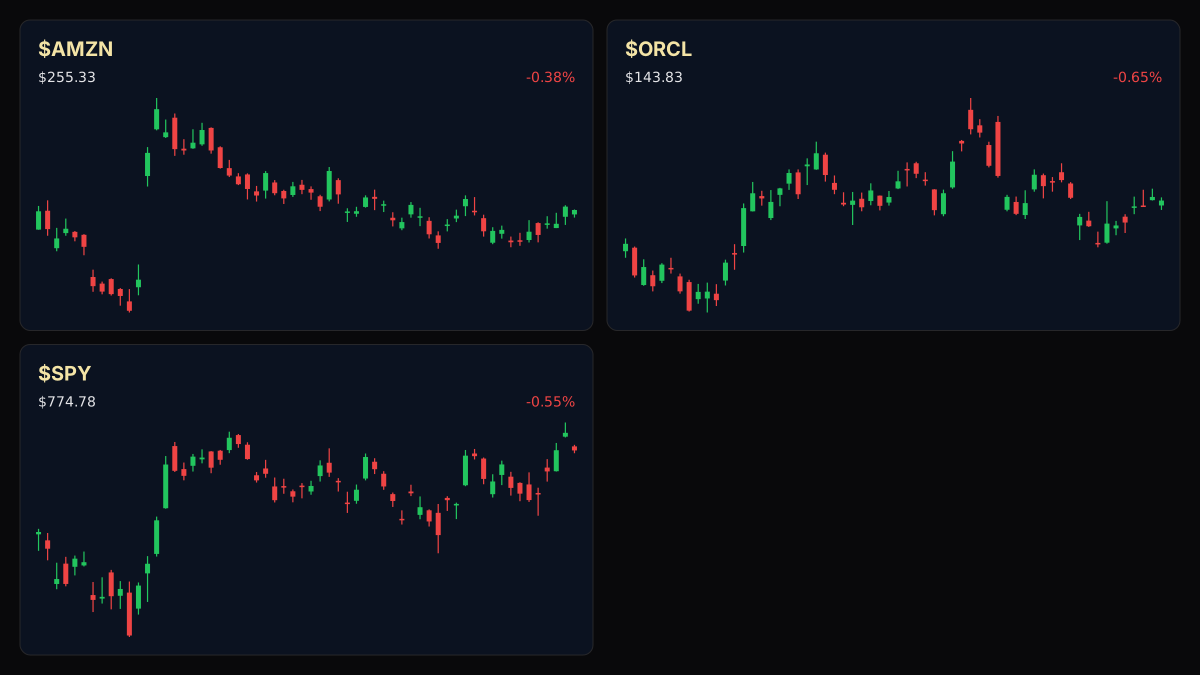
Educational TradingView chart — search any symbol in the widget. Confirm on /markets/SPY and related $ORCL, $AMZN. Not investment advice.
Related markets
Shares a vertical MP4 loop to your phone's camera roll or app share sheet (Instagram, TikTok, Facebook Reels).
Oracle Cloud Infrastructure revenue reached $7.388 billion, marking a 121% increase, while Amazon Web Services posted $42.232 billion, up 37%. Traders tracking hyperscale datacenter expansion are monitoring how capital intensity and hardware supply chains shape cloud economics heading toward 2027.
### Tape / Session Read Cloud infrastructure growth metrics underscore a massive capital deployment cycle across major enterprise providers. Oracle delivered 850 megawatts and over 300,000 GPUs, with utilization touching 97.9% and renewal pricing holding at a 20% premium. Meanwhile, Amazon leverages custom Trainium and Graviton silicon powering 98% of its top EC2 customers, alongside reserved capacity commitments from major AI developers.
### Why This Lane Matters The divergence between triple-digit percentage growth off a smaller base and multi-billion-dollar scale dictates capital allocation across enterprise software and semiconductor supply chains. Investors must navigate soaring infrastructure expenditure plans against near-term free cash flow burn and rising interest obligations.
### Money Play Cloud infrastructure expansion relies heavily on advanced silicon suppliers and datacenter builders. While no direct single-name tickers are featured in the primary verified data feed for this comparison, market participants closely track specialized hardware providers and hyperscale balance sheet metrics.
## Technical Analysis & Key Risk Watch — Cloud Infrastructure Tape
Broad technology sector tape reflects consolidation alongside broader market indices, with the S&P 500 closing at 7,795.60 (-0.52%) and the Nasdaq 100 at 31,037.50 (-0.80%). Traders should watch capital expenditure efficiency, interest expense trajectories, and GPU renewal pricing strength as key risk indicators.
Read the full story
Original reporting and related coverage — attribution links only, not paid recommendations.
Trade this story
 Robinhood
 Webull
 Tradier
 IBKR
IBKR
Chart this story
 TradingView
Broker and exchange buttons use invite / refer-a-friend links (rewards may be capped). Charting links (TradingView) are partner offers that may pay OppHub America a commission at no extra cost to you.
OppSHOP
Full OppSHOP →As an Amazon Associate, OppHub America earns from qualifying purchases. Shopping here helps keep the site free — at no extra cost to you. Disclosure

OppSHOP
Related to this story
Cloud infrastructure spending impacts enterprise hardware suppliers and
Shop related →

Investing books
Read the classics
Shop this pick →

Personal finance books
Run the household books
Shop this pick →

Trading notebooks
Write the thesis first
Shop this pick →

Monitor for charts
See every pane
Shop this pick →
Story playbook
A pre-built map of what to watch — stocks, ETFs, and educational next steps. Not personalized advice.
Snapshot date: October 7, 2026 at 9:56 AM ET
This playbook was built when the story published and is not live-updated. Prices, news, and risk can change after this date — treat it as a starting map, not a current trade ticket.
Story → money map
Cloud Infrastructure
Two major tech companies are spending billions of dollars to build massive computer centers for artificial intelligence. This big spending creates big opportunities for the companies that supply computer chips and equipment.
What changed
Oracle and Amazon reported contrasting cloud growth metrics, showcasing a multi-billion-dollar race for AI datacenter capacity heading into 2027.
Who wins / who loses
High-growth challengers and specialized hardware suppliers benefit from aggressive data center buildouts, while legacy providers face heavy capital expenditure pressure.
Time horizon
Think in terms of the next few months.
Confidence & best fit
medium confidence · Long-term investor, Active trader
Safer theme exposure (ETFs)
Baskets that own the theme without betting on one company.
- $SKYY — A single basket of many different cloud computing companies, lowering your risk if one struggles.
- $SMH — A fund holding the top chipmakers that supply the hardware for these massive computer networks.
- $XLK — A broad technology fund holding America's largest and most established software and hardware giants.
Single stocks (higher risk)
Primary = closest to the story · Peers = same industry · Second-order = knock-on effects · Avoid = looks related but may be a trap
Primary
- $AMZNBuild slowly — only if it fits your plan
Amazon makes billions renting out computer power and benefits directly when companies build artificial intelligence.
View $AMZN chart → · End-of-day delayed data
- $ORCLWatch — track, don’t rush
Oracle is growing its computer rental business very fast by signing up major AI customers, though it costs a lot of money to build.
View $ORCL chart → · End-of-day delayed data
Second-order
- $NVDABuild slowly — only if it fits your plan
This company makes the powerful computer chips that Amazon and Oracle need to run artificial intelligence programs.
View $NVDA chart → · End-of-day delayed data
Options (education only)
No strikes or expiries — a framework for how traders might express the view. Options can expire worthless.
Direction: volatile · Style: Debit spread (defined risk) · Level: intermediate
Options can be complex and risky for beginners; it is usually safer to stick to buying shares or ETFs while learning.
Income / OppHub America angle
Not a trade tip — ways to use the insight outside the market.
- Commercial real estate tied to regional datacenter hubs and local power grid suppliers.
What would break this thesis
- A sudden slowdown in enterprise AI software adoption or sharp increases in borrowing costs halting datacenter construction.
What to do next on OppHub America
Saved playbooks stay on this device for now.
Important
Not financial advice. OppHub America playbooks are educational market maps only — not recommendations to buy, sell, or hold any security. Markets move fast; information can be wrong or outdated. Trade and invest at your own risk. Do your own research or consult a licensed advisor.
Based on reporting from yahoo-tickers-tape-movers.
Informational and educational only — not investment, financial, or legal advice. Disclosure
Shares a vertical MP4 loop to your phone's camera roll or app share sheet (Instagram, TikTok, Facebook Reels).