Barry, OppHub America Desk · · Source: yahoo-tickers-tape-movers
Costco vs. Walmart: Dividend Strategies Compared for Investors
Investors seeking a higher current dividend yield and a long history of payout increases may find Walmart more attractive, while those prioritizing dividend growth and the potential for special dividends could favor Costco . Both companies are currently trading at valuations above their historical averages.
Based on reporting from yahoo-tickers-tape-movers.
Costco and Walmart present contrasting dividend strategies, with Walmart offering a higher current yield and a longer history of consecutive increases, while Costco's dividend growth rate and potential for special payouts stand out. Investors must weigh these factors against the current elevated valuations of both retail giants.
Market context for this story
As of: After HoursLoading quotes…
Informational only — not investment advice. Full markets →


$SPYSPDR S&P 500 ETF
TradingView
Live chart & market data via TradingView · OppHub classroom · Delayed or exchange real-time per TradingView data agreements · Not investment advice
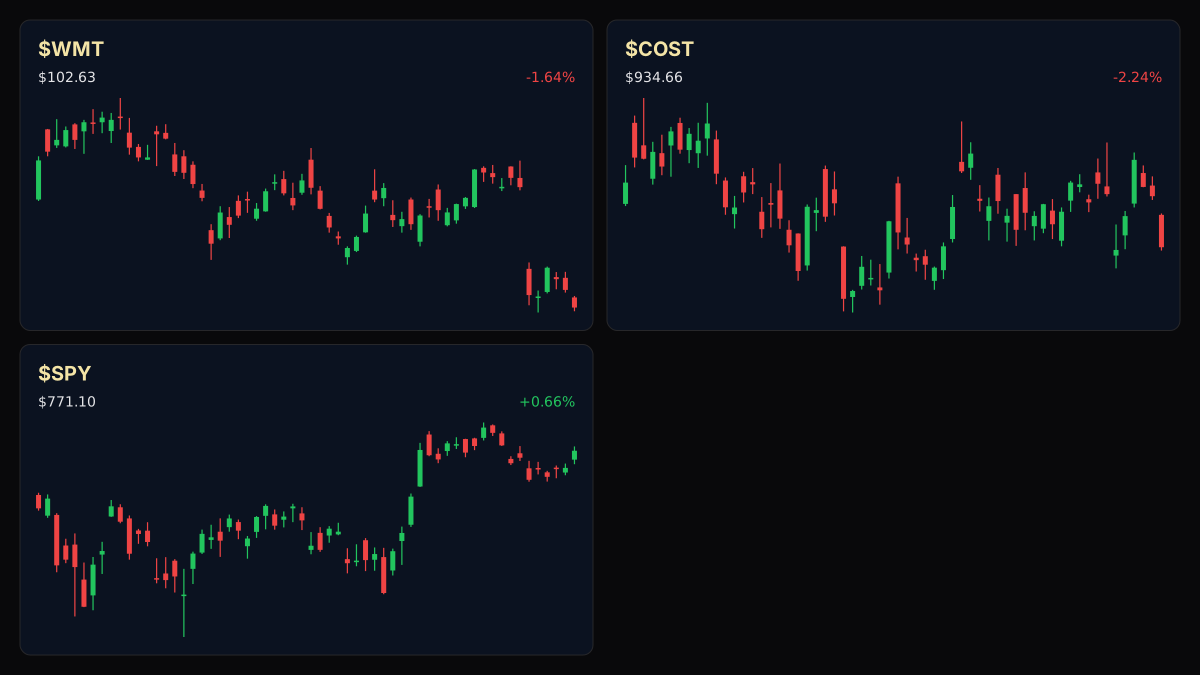
Educational TradingView chart — search any symbol in the widget. Confirm on /markets/SPY and related $WMT, $COST. Not investment advice.
Related markets
Shares a vertical MP4 loop to your phone's camera roll or app share sheet (Instagram, TikTok, Facebook Reels).
Costco Wholesale (NASDAQ: COST) and Walmart (NYSE: WMT) both offer reliable dividend streams, but their approaches differ significantly. Walmart, with a yield of approximately 0.9%, boasts a 53-year track record of consecutive dividend increases, positioning it as a Dividend King. Costco's current yield is lower at around 0.6%, though it has historically provided substantial special dividends, including payouts of $7, $10, and $15 per share in recent years.
Despite their differing dividend policies, both retailers are trading at valuations above their five-year averages, with yields below that of the S&P 500 index (^GSPC). For investors prioritizing immediate income and a stable, long-term payout history, Walmart's higher yield and consistent growth may be more appealing. However, Costco's dividend growth rate, around 10% annually compared to Walmart's 4%, coupled with its history of special dividends, could offer a more attractive proposition for those focused on dividend growth and reinvestment, albeit at a potentially higher valuation premium.
Key Data Points: Costco (COST): Current Yield 0.59%, Gross Margin 12.88%, Dividend Growth 10% (10-yr). Walmart (WMT): Current Yield 0.95%, Gross Margin 26.75%, Dividend Growth 4% (10-yr).
Investors considering either stock should be mindful of the current valuation environment, as neither company is considered inexpensive.
Read the full story
Original reporting and related coverage — attribution links only, not paid recommendations.
Trade this story
 Robinhood
 Webull
 Tradier
 IBKR
IBKR
Chart this story
 TradingView
Broker and exchange buttons use invite / refer-a-friend links (rewards may be capped). Charting links (TradingView) are partner offers that may pay OppHub America a commission at no extra cost to you.
OppSHOP
Full OppSHOP →As an Amazon Associate, OppHub America earns from qualifying purchases. Shopping here helps keep the site free — at no extra cost to you. Disclosure

OppSHOP
Related to this story
Investors seeking a higher current dividend yield and a long history of
Shop related →

Investing books
Read the classics
Shop this pick →

Personal finance books
Run the household books
Shop this pick →

Trading notebooks
Write the thesis first
Shop this pick →

Monitor for charts
See every pane
Shop this pick →
Story playbook
A pre-built map of what to watch — stocks, ETFs, and educational next steps. Not personalized advice.
Snapshot date: August 29, 2026 at 6:25 AM ET
This playbook was built when the story published and is not live-updated. Prices, news, and risk can change after this date — treat it as a starting map, not a current trade ticket.
Story → money map
retail dividend strategies
Walmart and Costco are both great stores, but their stock dividends work differently. Walmart pays a slightly higher regular cash reward to shareholders, while Costco grows its payout faster and occasionally hands out huge bonus cash gifts.
What changed
Retail sector valuation comparison highlights the trade-off between Walmart's higher current dividend yield and Costco's superior dividend growth rate and special payout history.
Who wins / who loses
Income-focused investors benefit from Walmart's stability, while long-term growth investors favor Costco's compounding potential, though both face pressure from expensive share prices.
Time horizon
Think in terms of the next few months.
Confidence & best fit
medium confidence · Long-term investor, Side income / builder
Safer theme exposure (ETFs)
Baskets that own the theme without betting on one company.
Single stocks (higher risk)
Primary = closest to the story · Peers = same industry · Second-order = knock-on effects · Avoid = looks related but may be a trap
Primary
- $WMTWatch — track, don’t rush
Walmart is great for steady cash flow because it has raised its payout for over 50 years, but the stock price is currently quite high.
View $WMT chart → · End-of-day delayed data
- $COSTWatch — track, don’t rush
Costco grows its dividend faster and sometimes gives out giant bonus payouts, but you have to pay a high price for the stock.
View $COST chart → · End-of-day delayed data
Peer
- $TGTWatch — track, don’t rush
Target is another big retailer that pays dividends, giving investors a similar option to compare against Walmart and Costco.
View $TGT chart → · End-of-day delayed data
Options (education only)
No strikes or expiries — a framework for how traders might express the view. Options can expire worthless.
Direction: range · Style: Covered-call income (only if you already own shares) · Level: intermediate
Beginners should skip options here and stick to buying shares, as option trading involves complex timing and risk.
Income / OppHub America angle
Not a trade tip — ways to use the insight outside the market.
- Reinvesting dividends automatically through a brokerage plan to compound retail stock ownership over time.
What would break this thesis
- A sharp correction in broad retail valuations or unexpected margin compression slowing down dividend growth.
What to do next on OppHub America
Saved playbooks stay on this device for now.
Important
Not financial advice. OppHub America playbooks are educational market maps only — not recommendations to buy, sell, or hold any security. Markets move fast; information can be wrong or outdated. Trade and invest at your own risk. Do your own research or consult a licensed advisor.
Based on reporting from yahoo-tickers-tape-movers.
Informational and educational only — not investment, financial, or legal advice. Disclosure
Shares a vertical MP4 loop to your phone's camera roll or app share sheet (Instagram, TikTok, Facebook Reels).