Barry, OppHub America Desk · · Source: yahoo-tickers-tape-movers
Elder Care Costs & Robotics: U.S. Long-Term Spending Analysis
Long-term elder care expenditures of up to $400 billion annually highlight structural economic pressures that influence healthcare and technology sector capital allocation.
Based on reporting from yahoo-tickers-tape-movers.
The United States allocates roughly $350 billion to $400 billion annually toward long-term elder care, representing up to 2% of national GDP according to recent economic data released on Sunday, September 27, 2026. This massive fiscal footprint underscores the expanding market for automated solutions as demographic pressures mount.
Market context for this story
As of: WeekendLoading quotes…
Informational only — not investment advice. Full markets →
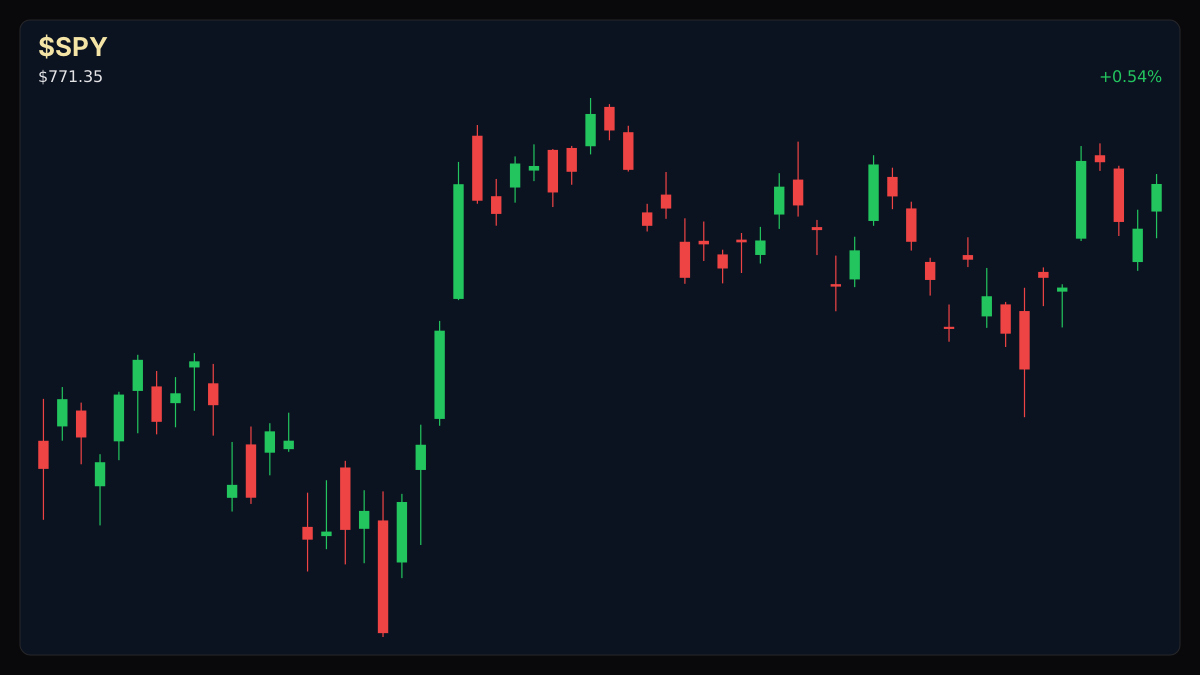
 SPDR S&P 500 ETF·$SPY
$SPYSPDR S&P 500 ETF
TradingView
Live chart & market data via TradingView · OppHub classroom · Delayed or exchange real-time per TradingView data agreements · Not investment advice
Educational TradingView chart — search any symbol in the widget. Confirm on /markets/SPY. Not investment advice.
Related markets
Shares a vertical MP4 loop to your phone's camera roll or app share sheet (Instagram, TikTok, Facebook Reels).
Long-term care expenditure across the United States accounts for approximately $350 billion to $400 billion per year, representing about 1.5% to 2% of total GDP. As highlighted on Sunday, September 27, 2026, these figures underscore the heavy structural costs associated with an aging population and the potential for technological automation to reshape care delivery.
### Money Play Market participants evaluating demographic shifts and automation themes should monitor broader healthcare and technology allocation trends as institutional capital assesses long-term care cost structures.
### Tape / Session Read U.S. markets concluded the recent reporting period with the S&P 500 settling at 7,743.41 (+0.51%), the Dow Jones Industrial Average advancing to 51,828.62 (+0.93%), and the Nasdaq Composite reaching 27,068.72 (+0.48%). Meanwhile, the Russell 2000 inched up to 2,837.55 (+0.07%), the 10-Year Treasury bond yield registered at 5.18 (+0.43%), and the VIX volatility index eased to 14.87 (-5.11%).
### Why This Lane Matters Sustained macro expenditures in long-term care create continuous fiscal pressure on households and public budgets alike, driving corporate innovation toward robotics and automated efficiency solutions to curb structural expenses.
Read the full story
Original reporting and related coverage — attribution links only, not paid recommendations.
Trade this story
 Robinhood
 Webull
 Tradier
 IBKR
IBKR
Chart this story
 TradingView
Broker and exchange buttons use invite / refer-a-friend links (rewards may be capped). Charting links (TradingView) are partner offers that may pay OppHub America a commission at no extra cost to you.
OppSHOP
Full OppSHOP →As an Amazon Associate, OppHub America earns from qualifying purchases. Shopping here helps keep the site free — at no extra cost to you. Disclosure

OppSHOP
Related to this story
Long-term elder care expenditures of up to $400 billion annually highlig
Shop related →

Investing books
Read the classics
Shop this pick →

Personal finance books
Run the household books
Shop this pick →

Trading notebooks
Write the thesis first
Shop this pick →

Monitor for charts
See every pane
Shop this pick →
Story playbook
A pre-built map of what to watch — stocks, ETFs, and educational next steps. Not personalized advice.
Snapshot date: September 27, 2026 at 1:17 PM ET
This playbook was built when the story published and is not live-updated. Prices, news, and risk can change after this date — treat it as a starting map, not a current trade ticket.
Story → money map
elder care robotics
America is spending up to $400 billion a year on nursing homes and elder care, which is a huge drain on budgets. Investors care because companies are starting to use robots and smart technology to cut these massive costs.
What changed
Economic data released in late September 2026 revealed that U.S. long-term elder care spending accounts for up to 2% of total GDP.
Who wins / who loses
Healthcare technology and robotics providers benefit from cost-pressure demand, while traditional labor-heavy care facilities face margin compression.
Time horizon
Think in terms of the next few months.
Confidence & best fit
medium confidence · Long-term investor
Safer theme exposure (ETFs)
Baskets that own the theme without betting on one company.
Single stocks (higher risk)
Primary = closest to the story · Peers = same industry · Second-order = knock-on effects · Avoid = looks related but may be a trap
Primary
- $ISRGWatch — track, don’t rush
A leading company making surgical and medical robots that could expand into broader care automation.
View $ISRG chart → · End-of-day delayed data
Peer
- $TDOCWatch — track, don’t rush
Virtual healthcare services that help patients consult doctors from home to save on costly facility visits.
View $TDOC chart → · End-of-day delayed data
Second-order
- $UNHBuild slowly — only if it fits your plan
A massive health insurance company that has to manage these expensive elder care costs every day.
View $UNH chart → · End-of-day delayed data
Options (education only)
No strikes or expiries — a framework for how traders might express the view. Options can expire worthless.
Beginners should skip options here entirely and stick to buying shares if they want to invest in this theme.
See options-friendly brokers →Income / OppHub America angle
Not a trade tip — ways to use the insight outside the market.
- Research local home healthcare and aging-in-place service providers in your region.
- Monitor state-level legislative changes regarding elder care funding and subsidies.
What would break this thesis
- A sudden slowdown in aging population growth metrics or government policy changes that significantly cap healthcare spending.
What to do next on OppHub America
Saved playbooks stay on this device for now.
Important
Not financial advice. OppHub America playbooks are educational market maps only — not recommendations to buy, sell, or hold any security. Markets move fast; information can be wrong or outdated. Trade and invest at your own risk. Do your own research or consult a licensed advisor.
Based on reporting from yahoo-tickers-tape-movers.
Informational and educational only — not investment, financial, or legal advice. Disclosure
Shares a vertical MP4 loop to your phone's camera roll or app share sheet (Instagram, TikTok, Facebook Reels).