Barry, OppHub America Desk · · Source: aljazeera-english
Iran War's Indirect Impact on Fed Rates: Analysts Weigh In
Defense spending: Budget and contract news often move primes, software peers, and defense ETFs.
Based on reporting from aljazeera-english.
Geopolitical events, particularly the conflict involving Iran, are indirectly influencing U.S. interest rate policy, according to analysts. While Iran's parliament speaker cited the Taylor equation to suggest Tehran could influence rates, experts maintain the Federal Reserve responds to broader economic conditions.
Market context for this story
As of: Regular HoursLoading quotes…
Informational only — not investment advice. Full markets →
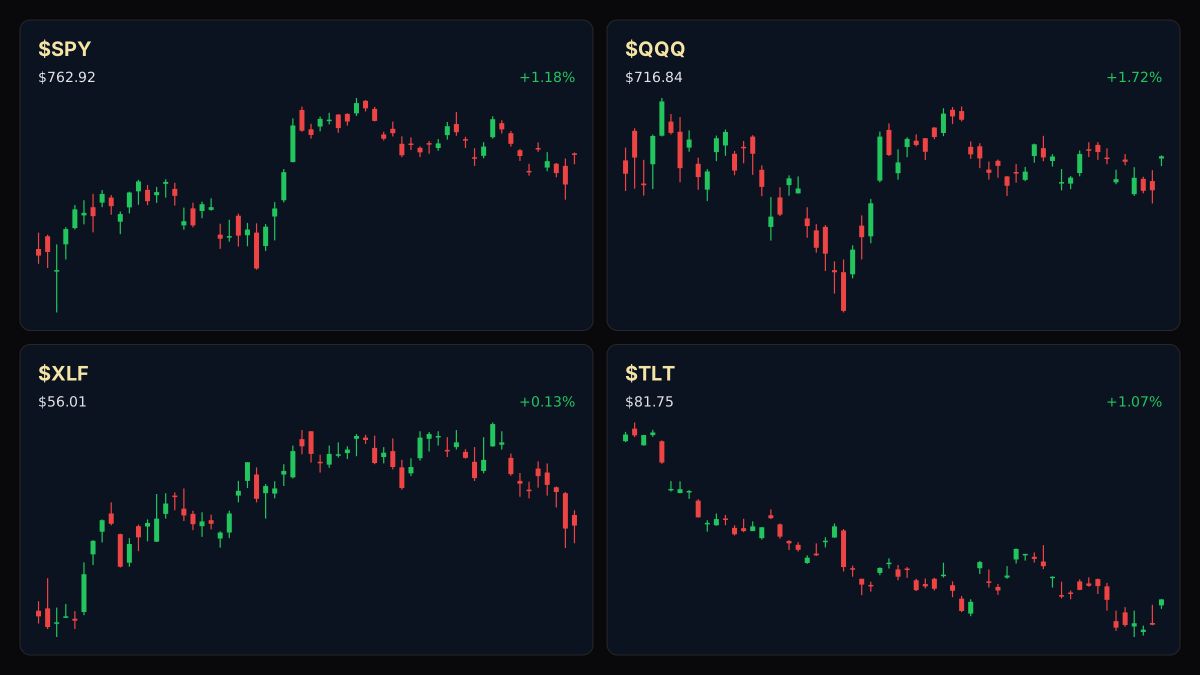
 SPDR S&P 500 ETF·$SPY
 Invesco QQQ Trust·$QQQ
 iShares 20+ Year Treasury·$TLT
 Financial Select Sector·$XLF
$SPYSPDR S&P 500 ETF
TradingView
Live chart & market data via TradingView · OppHub classroom · Delayed or exchange real-time per TradingView data agreements · Not investment advice
$QQQInvesco QQQ Trust
TradingView
Live chart & market data via TradingView · OppHub classroom · Delayed or exchange real-time per TradingView data agreements · Not investment advice
Educational TradingView charts — search any symbol in the widget. Confirm on /markets/SPY and related $QQQ, $TLT, $XLF. Not investment advice.
Related markets
Shares a vertical MP4 loop to your phone's camera roll or app share sheet (Instagram, TikTok, Facebook Reels).
Geopolitical tensions involving Iran are indirectly contributing to factors that influence U.S. interest rate decisions, according to market observers. Iran's Parliament Speaker Mohammad Bagher Ghalibaf suggested in a February 1, 2026, social media post that his country could influence U.S. interest rates, referencing the Taylor equation and citing "SOH risk premium" as something Iran "set." The Taylor equation is a formula economists use to estimate central bank interest rates based on inflation and economic output.
However, analysts like IG Group's Beauchamp and Streeter emphasize that the Federal Reserve's rate decisions are driven by a wider array of domestic economic indicators. Beauchamp stated that "the Iran war, indirectly, is a huge driver of last night’s hike, though no one wants to admit it," while Warsh noted that "There’s no hiding from hot spots around the world." Streeter, however, cautioned that Iran's actions are not definitively "setting" U.S. interest rates, suggesting the Fed was responding to a more comprehensive set of economic conditions.
### Executive Thesis While geopolitical events, specifically the conflict involving Iran, are cited by some as an indirect factor influencing the Federal Reserve's interest rate decisions, the consensus among analysts is that U.S. monetary policy remains primarily reactive to domestic inflation and labor market conditions.
### The Print This section details commentary on the relationship between geopolitical events and U.S. interest rates, rather than a specific economic print.
### Market Reaction No specific market reactions to the commentary on Iran's influence on interest rates were detailed in the provided facts.
### What It Means for Policy & Positioning The commentary suggests that while external geopolitical factors can create economic conditions, such as impacting oil prices, that may influence inflation and thus indirectly affect the Federal Reserve's dual mandate, U.S. policy decisions are fundamentally tethered to domestic economic data.
### Next Calendar Watch No specific upcoming dates for related commentary or data releases were provided.
Read the full story
Original reporting and related coverage — attribution links only, not paid recommendations.
Trade this story
 Robinhood
 Webull
 Tradier
 IBKR
IBKR
Chart this story
 TradingView
Broker and exchange buttons use invite / refer-a-friend links (rewards may be capped). Charting links (TradingView) are partner offers that may pay OppHub America a commission at no extra cost to you.
OppSHOP
Full OppSHOP →As an Amazon Associate, OppHub America earns from qualifying purchases. Shopping here helps keep the site free — at no extra cost to you. Disclosure

OppSHOP
Related to this story
Defense spending: Budget and contract news often move primes, software p
Shop related →

Investing books
Read the classics
Shop this pick →

Personal finance books
Run the household books
Shop this pick →

Trading notebooks
Write the thesis first
Shop this pick →

Monitor for charts
See every pane
Shop this pick →
Story playbook
A pre-built map of what to watch — stocks, ETFs, and educational next steps. Not personalized advice.
Snapshot date: September 17, 2026 at 3:08 PM ET
This playbook was built when the story published and is not live-updated. Prices, news, and risk can change after this date — treat it as a starting map, not a current trade ticket.
Story → money map
geopolitical interest rate risk
Tensions involving Iran are causing worry about inflation and interest rates in the U.S. Investors care because global conflicts often push up government spending on defense and energy costs.
What changed
Analysts are debating whether Middle East conflicts are indirectly forcing the Federal Reserve to keep interest rates higher for longer due to inflation risks.
Who wins / who loses
Defense contractors and energy producers may benefit from heightened global tension, while rate-sensitive sectors and borrowers could face higher costs.
Time horizon
Think in terms of the next few months.
Confidence & best fit
low confidence · Long-term investor
Low confidence → prefer ETFs and “Watch,” not rushing into one stock.
Safer theme exposure (ETFs)
Baskets that own the theme without betting on one company.
Single stocks (higher risk)
Primary = closest to the story · Peers = same industry · Second-order = knock-on effects · Avoid = looks related but may be a trap
Primary
- $LMTWatch — track, don’t rush
Makes military equipment and often sees more interest when global tensions rise.
View $LMT chart → · End-of-day delayed data
Peer
- $XOMWatch — track, don’t rush
A major oil company that can benefit if global conflicts cause energy prices to rise.
View $XOM chart → · End-of-day delayed data
Options (education only)
No strikes or expiries — a framework for how traders might express the view. Options can expire worthless.
Beginners should skip options here because news-driven market swings are too unpredictable.
See options-friendly brokers →Income / OppHub America angle
Not a trade tip — ways to use the insight outside the market.
- Monitor personal borrowing rates and consider locking in fixed rates if inflation fears persist.
What would break this thesis
- The Federal Reserve explicitly lowers rates regardless of geopolitical tension, or Middle East conflicts de-escalate rapidly.
What to do next on OppHub America
Saved playbooks stay on this device for now.
Important
Not financial advice. OppHub America playbooks are educational market maps only — not recommendations to buy, sell, or hold any security. Markets move fast; information can be wrong or outdated. Trade and invest at your own risk. Do your own research or consult a licensed advisor.
Based on reporting from aljazeera-english.
Informational and educational only — not investment, financial, or legal advice. Disclosure
Shares a vertical MP4 loop to your phone's camera roll or app share sheet (Instagram, TikTok, Facebook Reels).