Barry, OppHub America Desk · · Source: oilprice-main
US LNG Exports Face Tariff Hurdles as Trade Talks Open
Energy sector participants should monitor bilateral trade discussions regarding . liquefied natural gas tariffs and export capacity agreements.
Based on reporting from oilprice-main.
Washington enters bilateral trade discussions with Beijing regarding a potential revival of a $6 billion-a-year liquefied natural gas trade, contingent on lifting a 15% Chinese tariff. The restriction has effectively halted direct U.S. shipments to China since early 2025.
Market context for this story
As of: Regular HoursLoading quotes…
Informational only — not investment advice. Full markets →

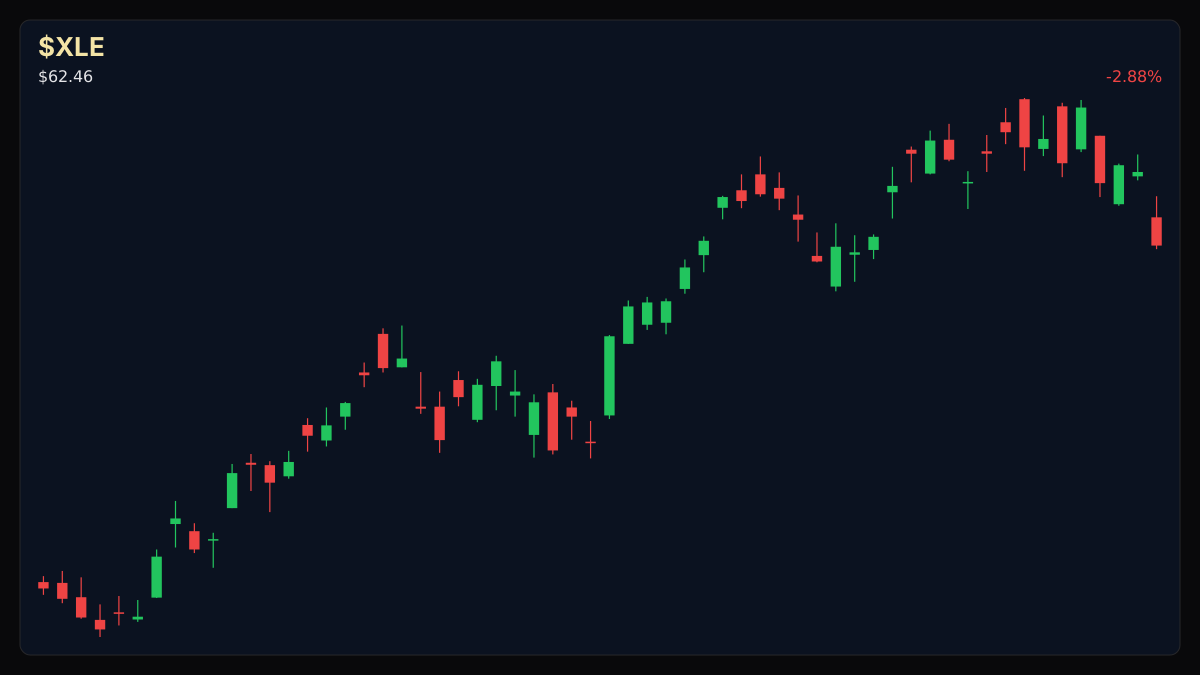
$XLEEnergy Select Sector
TradingView
Live chart & market data via TradingView · OppHub classroom · Delayed or exchange real-time per TradingView data agreements · Not investment advice
Educational TradingView chart — search any symbol in the widget. Confirm on /markets/XLE. Not investment advice.
Related markets
Shares a vertical MP4 loop to your phone's camera roll or app share sheet (Instagram, TikTok, Facebook Reels).
### Money Play Traders tracking broader energy infrastructure and energy exchange-traded funds should monitor developments around tariff negotiations and bilateral trade policy.
## Catalyst Analysis: What Changed Diplomatic talks in Washington focus on reviving U.S. liquefied natural gas exports to China, centered on the removal of a 15% tariff imposed in February 2025. Prior to the trade restrictions, U.S. cargoes accounted for 12% of China's total LNG imports in 2021, valued at $6.2 billion. While long-term supply contracts remained active, buyers previously redirected cargoes to alternative markets rather than absorb tariff costs.
## Impact on Mapped Tickers and Sectors The energy sector continues to navigate supply realignments following infrastructure damage in Qatar, which lost roughly 17% of its export capacity due to regional conflict. Concurrently, new long-term supply commitments—such as a 20-year agreement for 500,000 metric tons annually starting in 2030—demonstrate sustained demand for U.S. export capacity despite ongoing tariff structures.
### Winners, Uncertainties and Trade Flows - **Winners:** U.S. export developers securing long-term offtake agreements and international buyers utilizing spot cargoes to cover supply shortfalls. - **Uncertainties:** The exact timeline for tariff removal and potential shifts in long-term demand forecasts across Asian markets.
### Risk Watch — Legal and Timeline Considerations Market participants must monitor regulatory filings and official trade announcements for confirmation of policy changes. Recent baseline forecasts from major energy analysts indicate adjustments to Chinese demand growth through the early 2030s, independent of near-term bilateral diplomatic outcomes.
Read the full story
Original reporting and related coverage — attribution links only, not paid recommendations.
Trade this story
 Robinhood
 Webull
 Tradier
 IBKR
IBKR
Chart this story
 TradingView
Broker and exchange buttons use invite / refer-a-friend links (rewards may be capped). Charting links (TradingView) are partner offers that may pay OppHub America a commission at no extra cost to you.
OppSHOP
Full OppSHOP →As an Amazon Associate, OppHub America earns from qualifying purchases. Shopping here helps keep the site free — at no extra cost to you. Disclosure

OppSHOP
Related to this story
Energy sector participants should monitor bilateral trade discussions re
Shop related →

Investing books
Read the classics
Shop this pick →

Personal finance books
Run the household books
Shop this pick →

Trading notebooks
Write the thesis first
Shop this pick →
Monitor for charts
See every pane
Shop this pick →
Story playbook
A pre-built map of what to watch — stocks, ETFs, and educational next steps. Not personalized advice.
Snapshot date: September 22, 2026 at 8:08 PM ET
This playbook was built when the story published and is not live-updated. Prices, news, and risk can change after this date — treat it as a starting map, not a current trade ticket.
Story → money map
LNG exports and trade policy
The U.S. and China are talking about removing a tax on American natural gas exports. This matters because it could restart billions of dollars in energy sales between the two countries.
What changed
Bilateral trade discussions opened in Washington regarding the potential removal of a 15% Chinese tariff on U.S. liquefied natural gas shipments.
Who wins / who loses
U.S. export developers and buyers utilizing spot cargoes stand to benefit, while companies hampered by trade restrictions face ongoing uncertainty until tariffs are lifted.
Time horizon
Think in terms of the next few months.
Confidence & best fit
medium confidence · Long-term investor, Active trader
Safer theme exposure (ETFs)
Baskets that own the theme without betting on one company.
Single stocks (higher risk)
Primary = closest to the story · Peers = same industry · Second-order = knock-on effects · Avoid = looks related but may be a trap
Primary
- $LNGWatch — track, don’t rush
This company handles large-scale natural gas exports and benefits if trade barriers with China disappear.
View $LNG chart → · End-of-day delayed data
Peer
- $EQTWatch — track, don’t rush
A major natural gas producer that could see higher demand if more gas is shipped overseas.
View $EQT chart → · End-of-day delayed data
Second-order
- $SEMRYWatch — track, don’t rush
Companies that build or operate energy shipping infrastructure could see more business.
Options (education only)
No strikes or expiries — a framework for how traders might express the view. Options can expire worthless.
Beginners should skip options here because trade talks are unpredictable and headlines can cause sudden price swings.
See options-friendly brokers →Income / OppHub America angle
Not a trade tip — ways to use the insight outside the market.
- Monitor regional Gulf Coast port activity and local energy infrastructure expansion projects.
What would break this thesis
- A formal breakdown in trade talks or the permanent continuation of the 15% tariff by Beijing.
What to do next on OppHub America
Saved playbooks stay on this device for now.
Important
Not financial advice. OppHub America playbooks are educational market maps only — not recommendations to buy, sell, or hold any security. Markets move fast; information can be wrong or outdated. Trade and invest at your own risk. Do your own research or consult a licensed advisor.
Based on reporting from oilprice-main.
Informational and educational only — not investment, financial, or legal advice. Disclosure
Shares a vertical MP4 loop to your phone's camera roll or app share sheet (Instagram, TikTok, Facebook Reels).