Barry, OppHub America Desk · · Source: yahoo-tickers-tape-movers
Goldman Sachs: AI Capex to Hit $1 Trillion in 2026
Goldman Sachs' revised capex forecast suggests a robust demand environment for infrastructure components. Investors looking to capitalize on this trend may consider semiconductor manufacturers and cloud service providers that are integral to scaling capabilities globally.
Based on reporting from yahoo-tickers-tape-movers.
Goldman Sachs predicts global AI capital expenditures could reach $1 trillion in 2026, surpassing current consensus estimates. This surge is driven by significant investment from private companies and entities outside the U.S., particularly in Asia, challenging prevailing market views. This forecast suggests a potential acceleration in the AI infrastructure build-out, impacting semiconductor demand and related technology sectors.
Market context for this story
As of: After HoursLoading quotes…
Informational only — not investment advice. Full markets →


$NVDA
TradingView
Live chart & market data via TradingView · OppHub classroom · Delayed or exchange real-time per TradingView data agreements · Not investment advice
Educational TradingView chart — search any symbol in the widget. Confirm on /markets/NVDA and related $GS. Not investment advice.
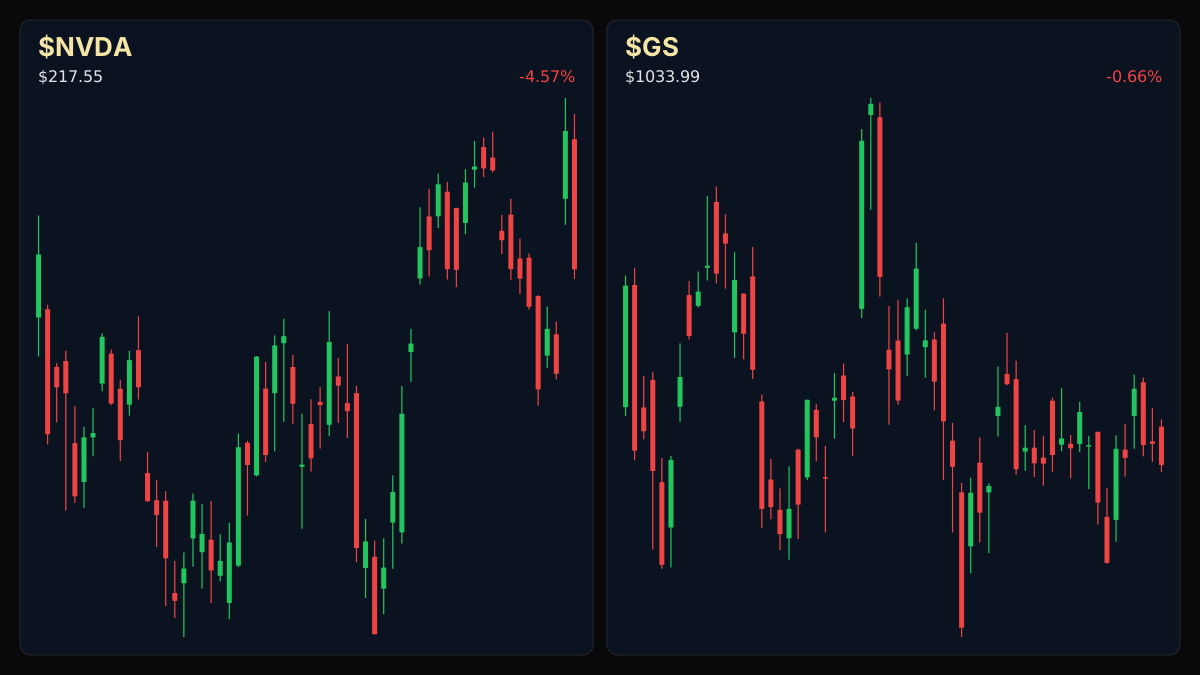
Related markets
Shares a vertical MP4 loop to your phone's camera roll or app share sheet (Instagram, TikTok, Facebook Reels).
**Implied Volatility / Movement:** Goldman Sachs strategists have revised their outlook for global artificial intelligence capital expenditures, projecting a potential reach of $1 trillion in 2026. This figure significantly exceeds the current consensus estimate of approximately $800 billion for the same year. The upward revision is attributed to the inclusion of investment by private AI companies and entities operating outside the United States, which are often excluded from broader market calculations.
### Money Play Goldman Sachs' revised AI capex forecast suggests a robust demand environment for AI infrastructure components. Investors looking to capitalize on this trend may consider semiconductor manufacturers and cloud service providers that are integral to scaling AI capabilities globally. ## Catalyst Analysis: AI Capex Forecast Revision Goldman Sachs strategists anticipate that global AI capital expenditures could surpass $1 trillion in 2026, a notable increase from the $800 billion consensus estimate. This divergence in forecasts stems from the inclusion of investments by private companies and international entities, particularly those in Asia, which are often not fully captured in current market projections.
McKinsey & Co. estimates that AI capex could reach $7 trillion globally by 2030, characterizing it as one of the largest infrastructure build-outs in modern history. Despite some analysts cautioning about the pace of AI adoption, others highlight that AI companies are backing their growth projections with tangible revenue increases. This environment, coupled with the strong financial positions of leading AI firms, supports aggressive investment. ## $NVDA+WL Technical Analysis & Key Risk Watch
### Sector Ripple / Impact on Semiconductors Goldman Sachs' projection of accelerated AI capital expenditures, potentially reaching $1 trillion in 2026, underscores the significant demand for advanced semiconductor technology. Nvidia (NASDAQ: NVDA), a leading provider of AI GPUs, is positioned to benefit from this trend, despite recent trading volatility. While U.S. companies are significant customers, approximately 10% of Nvidia's revenue is derived from Taiwan, indicating a global customer base.
Read the full story
Original reporting and related coverage — attribution links only, not paid recommendations.
Trade this story
 Robinhood
 Webull
 Tradier
 IBKR
IBKR
Chart this story
 TradingView
Broker and exchange buttons use invite / refer-a-friend links (rewards may be capped). Charting links (TradingView) are partner offers that may pay OppHub America a commission at no extra cost to you.
OppSHOP
Full OppSHOP →As an Amazon Associate, OppHub America earns from qualifying purchases. Shopping here helps keep the site free — at no extra cost to you. Disclosure

OppSHOP
Related to this story
Goldman Sachs' revised capex forecast suggests a robust demand environme
Shop related →

Investing books
Read the classics
Shop this pick →

Personal finance books
Run the household books
Shop this pick →

Trading notebooks
Write the thesis first
Shop this pick →
Monitor for charts
See every pane
Shop this pick →
Story playbook
A pre-built map of what to watch — stocks, ETFs, and educational next steps. Not personalized advice.
Snapshot date: August 31, 2026 at 3:26 AM ET
This playbook was built when the story published and is not live-updated. Prices, news, and risk can change after this date — treat it as a starting map, not a current trade ticket.
Story → money map
AI Infrastructure Capex
A major Wall Street bank predicted that spending on artificial intelligence will hit $1 trillion a year by 2026, which is higher than most people thought. Investors care because companies building the computer chips and data centers will make a lot of money.
What changed
Goldman Sachs increased its 2026 global AI capital expenditure forecast to $1 trillion, exceeding consensus estimates.
Who wins / who loses
Semiconductor and cloud infrastructure providers benefit from surging global demand, while legacy tech lacking AI integration risks falling behind.
Time horizon
Think in terms of the next few months.
Confidence & best fit
high confidence · Long-term investor, Active trader
Safer theme exposure (ETFs)
Baskets that own the theme without betting on one company.
Single stocks (higher risk)
Primary = closest to the story · Peers = same industry · Second-order = knock-on effects · Avoid = looks related but may be a trap
Primary
- $GSBuild slowly — only if it fits your plan
Goldman Sachs is the bank forecasting this trend and helping tech giants raise money for it.
View $GS chart → · End-of-day delayed data
- $NVDABuild slowly — only if it fits your plan
Nvidia makes the advanced computer chips that power almost all serious artificial intelligence work.
View $NVDA chart → · End-of-day delayed data
Peer
- $TSMWatch — track, don’t rush
Taiwan Semiconductor physically manufactures the high-tech computer chips designed by companies like Nvidia.
View $TSM chart → · End-of-day delayed data
Second-order
- $MSFTBuild slowly — only if it fits your plan
Microsoft runs massive cloud computer networks that businesses use to build AI.
View $MSFT chart → · End-of-day delayed data
Options (education only)
No strikes or expiries — a framework for how traders might express the view. Options can expire worthless.
Direction: bullish · Style: Debit spread (defined risk) · Level: intermediate
Beginners should skip options because they are complex and risky; buying a spread lets you bet on growth with defined risk.
Income / OppHub America angle
Not a trade tip — ways to use the insight outside the market.
- Commercial real estate and utility providers near major data center hubs in Northern Virginia and Asia.
What would break this thesis
- Macroeconomic downturn forcing enterprise tech budget cuts or tightening monetary policy restricting private funding.
What to do next on OppHub America
Saved playbooks stay on this device for now.
Important
Not financial advice. OppHub America playbooks are educational market maps only — not recommendations to buy, sell, or hold any security. Markets move fast; information can be wrong or outdated. Trade and invest at your own risk. Do your own research or consult a licensed advisor.
Based on reporting from yahoo-tickers-tape-movers.
Informational and educational only — not investment, financial, or legal advice. Disclosure
Shares a vertical MP4 loop to your phone's camera roll or app share sheet (Instagram, TikTok, Facebook Reels).