Barry, OppHub America Desk · · Source: yahoo-tickers-tape-movers
Microsoft Mobile Virtualization Market Set to Reach $21B by 2032
If enterprise mobile virtualization deployment scales across regulated sectors, watch and because rising cloud integration and secure containerization support long-term software revenue expansion.
Based on reporting from yahoo-tickers-tape-movers.
Enterprise mobility and BYOD adoption are driving the global mobile virtualization market toward an estimated $21.0 billion valuation by 2032, according to industry research highlighting key players like Microsoft and Google. Traders examining cloud infrastructure and enterprise security segments note that multi-year compound annual growth rates approach 21.1%.
Market context for this story
As of: Regular HoursLoading quotes…
Informational only — not investment advice. Full markets →


$MSFTMicrosoft
TradingView
Live chart & market data via TradingView · OppHub classroom · Delayed or exchange real-time per TradingView data agreements · Not investment advice
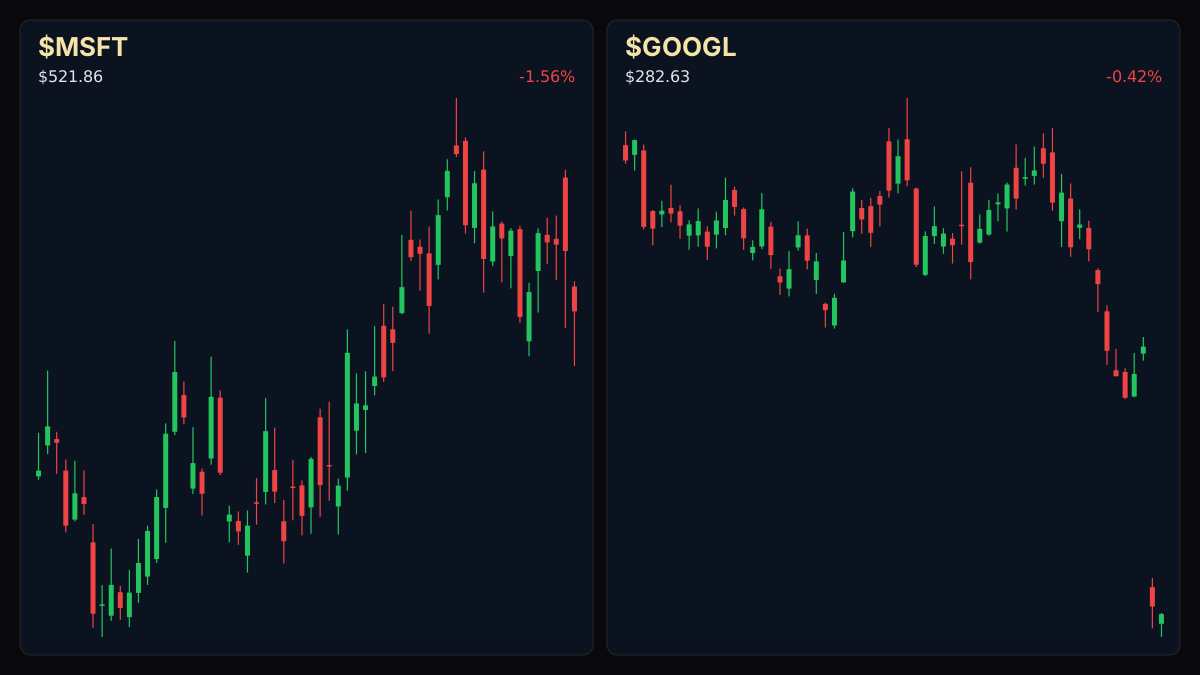
Educational TradingView chart — search any symbol in the widget. Confirm on /markets/MSFT and related $GOOGL. Not investment advice.
Related markets
Shares a vertical MP4 loop to your phone's camera roll or app share sheet (Instagram, TikTok, Facebook Reels).
**Implied Volatility / Movement:** Microsoft (NASDAQ: MSFT) shares trade at $533.52 (+0.84% on the session), holding above the 50-day moving average of $506.20 with an RSI-14 reading of 65.5.
### Money Play If enterprise mobility and bring-your-own-device deployments continue to scale across regulated industries, watch Microsoft ($MSFT+WL) and Alphabet ($GOOGL+WL) because robust cloud integration and secure containerization expand enterprise software margins through 2032. For more on Microsoft's long-term capital allocation strategies, see our previous analysis on [Microsoft Dividend Growth](/explore/microsoft-dividend-growth-fcf-coverage-payout-increases).
### Catalyst Analysis: Enterprise Mobility and Virtualization Expansion The global mobile virtualization market, valued at US$5.5 billion in 2025, is projected to surge to US$21.0 billion by 2032, expanding at a compound annual growth rate of 21.1%. This expansion is underpinned by rising remote work demands, bring-your-own-device (BYOD) policies, and stringent data protection mandates across healthcare, financial services, and government sectors. Organizations increasingly deploy virtualization tools to segregate corporate workflows from personal data on employee devices using isolated operating environments and application containers.
### Story Arc / How We Got Here Today's market expansion builds on our previous coverage of Microsoft's robust cash generation and disciplined capital allocation. As detailed in our [2026 archive report on Microsoft's dividend growth](/explore/microsoft-dividend-growth-fcf-coverage-payout-increases), free cash flow comfortably covers expanding software and cloud infrastructure outlays, reinforcing Microsoft's leadership in enterprise virtualization alongside peers like Alphabet ($GOOGL+WL).
### Technical Analysis & Key Risk Watch Key levels for Microsoft ($MSFT+WL) (educational): R2 $542.74 · R1 $535.57 · last $533.52 · S1 $532.54 · S2 $526.24. Volume trades at approximately 0.81x of its 20-day average, indicating measured consolidation near recent highs as technical momentum holds above the 50-day moving average.
### Impact on Enterprise Software and Cloud Infrastructure Technological breakthroughs—including lightweight hypervisors, secure sandboxing, and the rollout of low-latency 5G networks—continue to optimize performance on mobile hardware. North America remains a dominant hub backed by an estimated US$1.6 billion U.S. mobile virtualization baseline in 2025, while European and Asia-Pacific markets demonstrate accelerating demand driven by regulatory compliance frameworks.
Read the full story
Original reporting and related coverage — attribution links only, not paid recommendations.
Trade this story
 Robinhood
 Webull
 Tradier
 IBKR
Chart this story
 TradingView
Broker and exchange buttons use invite / refer-a-friend links (rewards may be capped). Charting links (TradingView) are partner offers that may pay OppHub America a commission at no extra cost to you.
OppSHOP
Full OppSHOP →As an Amazon Associate, OppHub America earns from qualifying purchases. Shopping here helps keep the site free — at no extra cost to you. Disclosure

OppSHOP
Related to this story
If enterprise mobile virtualization deployment scales across regulated s
Shop related →

Investing books
Read the classics
Shop this pick →

Personal finance books
Run the household books
Shop this pick →

Trading notebooks
Write the thesis first
Shop this pick →

Monitor for charts
See every pane
Shop this pick →
Story playbook
A pre-built map of what to watch — stocks, ETFs, and educational next steps. Not personalized advice.
Snapshot date: October 30, 2026 at 11:31 AM ET
This playbook was built when the story published and is not live-updated. Prices, news, and risk can change after this date — treat it as a starting map, not a current trade ticket.
Story → money map
enterprise cloud virtualization
Companies are increasingly letting employees use personal devices for work securely, which creates a huge multi-billion dollar market for tech giants. Investors care because this trend locks businesses into cloud and software subscriptions for years.
What changed
Industry projections show the mobile virtualization market scaling rapidly toward $21 billion by 2032.
Who wins / who loses
Cloud and enterprise software leaders benefit from secure device integration, while legacy isolated IT hardware providers risk losing relevance.
Time horizon
Think in terms of the next few months.
Confidence & best fit
medium confidence · Long-term investor
Safer theme exposure (ETFs)
Baskets that own the theme without betting on one company.
- $CLOU — An easy way to invest in a basket of cloud computing companies instead of just one stock.
- $SKYY — A diversified cloud ETF that spreads your money across many businesses building secure work software.
Single stocks (higher risk)
Primary = closest to the story · Peers = same industry · Second-order = knock-on effects · Avoid = looks related but may be a trap
Primary
- $MSFTWatch — track, don’t rush
Microsoft benefits as companies buy its cloud tools to keep work data safe on personal phones.
View $MSFT chart → · End-of-day delayed data
Peer
- $GOOGLWatch — track, don’t rush
Google captures enterprise software and cloud security revenue from the same remote work boom.
View $GOOGL chart → · End-of-day delayed data
Options (education only)
No strikes or expiries — a framework for how traders might express the view. Options can expire worthless.
Beginners should skip options here and stick to buying shares or ETFs for the long haul.
See options-friendly brokers →Income / OppHub America angle
Not a trade tip — ways to use the insight outside the market.
- Look into cybersecurity certification programs for IT professionals implementing BYOD policies.
What would break this thesis
- Macroeconomic slowdowns causing enterprise IT budget contractions or delayed cloud software migrations.
What to do next on OppHub America
Saved playbooks stay on this device for now.
Important
Not financial advice. OppHub America playbooks are educational market maps only — not recommendations to buy, sell, or hold any security. Markets move fast; information can be wrong or outdated. Trade and invest at your own risk. Do your own research or consult a licensed advisor.
Based on reporting from yahoo-tickers-tape-movers.
Informational and educational only — not investment, financial, or legal advice. Disclosure
Shares a vertical MP4 loop to your phone's camera roll or app share sheet (Instagram, TikTok, Facebook Reels).