Barry, OppHub America Desk · · Source: yahoo-megacap-tickers
Qualcomm (QCOM) Shares Dip 5% Premarket on Higher Costs, Apple Weakness
Investors should monitor the broader semiconductor sector for potential cost inflation and pricing power dynamics impacting chipmakers following Qualcomm's disclosure. While
Based on reporting from yahoo-megacap-tickers.
Qualcomm (NASDAQ: QCOM) shares declined approximately 5% in premarket trading today, Thursday, July 30, 2026, as increased memory costs and softer demand from Apple for its chips prompted concerns about near-term profit forecasts for the chipmaker. This impacts U.S. investors seeking insight into semiconductor supply chain pressures.
Market context for this story
As of: PremarketLoading quotes…
Informational only — not investment advice. Full markets →


$AAPLApple
TradingView
Live chart & market data via TradingView · OppHub classroom · Delayed or exchange real-time per TradingView data agreements · Not investment advice
Educational TradingView chart — search any symbol in the widget. Confirm on /markets/AAPL and related $QCOM. Not investment advice.
Related markets
Shares a vertical MP4 loop to your phone's camera roll or app share sheet (Instagram, TikTok, Facebook Reels).
Qualcomm (NASDAQ: QCOM) shares declined approximately 5% in premarket trading today, Thursday, July 30, 2026, as increased memory costs and softer demand from Apple for its chips prompted concerns about near-term profit forecasts for the chipmaker. The company is facing heightened expenses across its semiconductor supply chain, including for memory, wafers, packaging, and testing. These elevated costs, driven by a surge in AI infrastructure spending, are expected to be passed on to customers through double-digit price increases. This development could impact future revenue streams and overall profitability for the U.S. wireless technology giant.
### Money Play Investors may observe broader trends within the semiconductor sector for ripple effects stemming from supply chain cost pressures. While ## Catalyst Analysis: Rising Semiconductor Input Costs The primary driver behind Qualcomm's premarket decline is the dual pressure of rising operational costs within its supply chain and a reported decline in chip revenue from Apple. The global push for AI infrastructure has significantly tightened the semiconductor market, leading to higher prices for essential components such as memory and processing wafers. Qualcomm's strategy to implement double-digit price increases to offset these costs could influence customer relationships and sales volumes in the coming quarters.
### Supply Chain & Competitive Map — named links only from facts The current environment of tightened semiconductor supply chains, exacerbated by robust AI infrastructure spending, indicates a generalized increase in costs for critical components. Qualcomm explicitly cited rising expenses for memory, wafers, packaging, and testing. While the source does not detail specific competitive implications, the ability to pass on these costs through price hikes suggests a degree of pricing power within its market segments.
### CapEx & Hyperscaler Implications The surge in AI infrastructure spending, a key underlying factor in the rising semiconductor costs, implies continued high demand from hyperscalers and enterprises investing in AI capabilities. This demand, while driving up component prices in the short term, also signals a long-term growth trajectory for the semiconductor industry as a whole. Companies like Qualcomm, integral to these supply chains, are navigating the immediate cost challenges while potentially benefiting from sustained AI-driven demand.
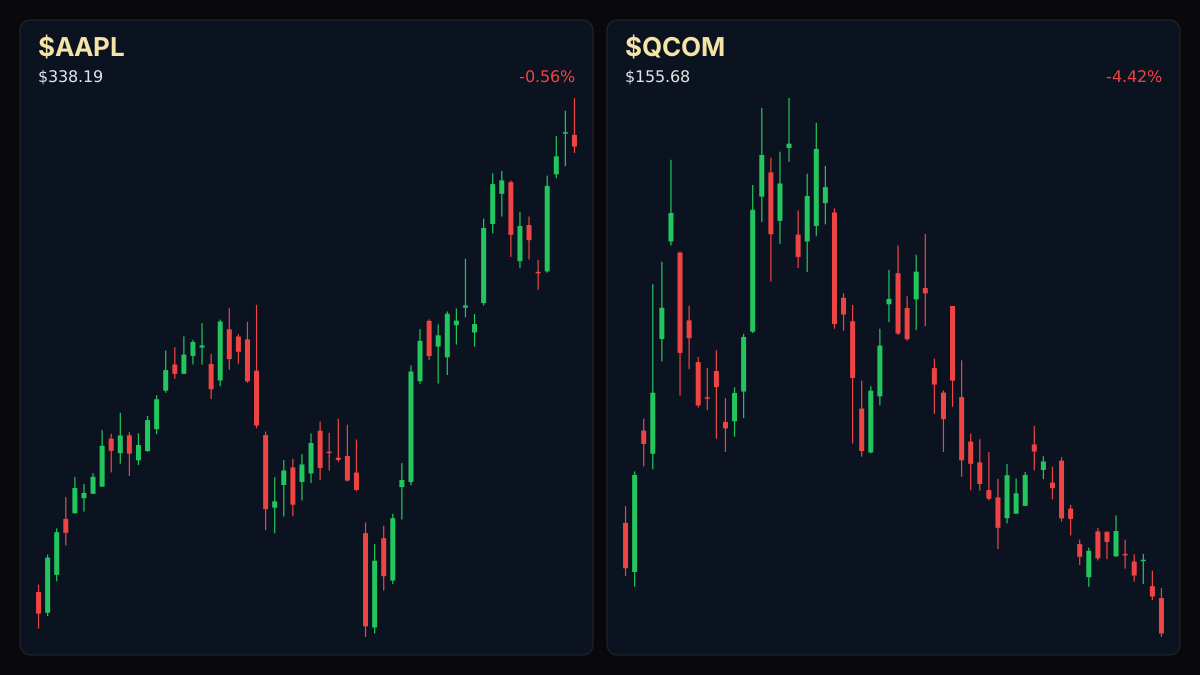
## $QCOM+WL Technical Analysis & Key Risk Watch Qualcomm's stock ($QCOM+WL) saw a premarket decline of 5% from its last closing price of $155.67999267578125, pushing its RSI14 to an extremely oversold 17.5. This sharp movement sets the stock significantly below its SMA50 of $200.51 and SMA200 of $169.09, indicating strong bearish momentum. The elevated volume, at 1.39x its 20-day average, underscores the significance of the premarket move. Investors will be watching for potential support levels following this sharp decline, particularly if the market perceives a flight to quality or a change in sentiment toward high-cost input-driven industries. For Apple ($AAPL+WL), the perceived weakness in demand for Qualcomm's chips did not significantly impact its premarket trading, with a slight gain of 0.81% and an RSI14 of 72.1, nearing overbought conditions after closing at $339.6499938964844.
Read the full story
Original reporting and related coverage — attribution links only, not paid recommendations.
Trade this story
 Robinhood
 Webull
 Tradier
 IBKR
IBKR
Chart this story
 TradingView
Broker and exchange buttons use invite / refer-a-friend links (rewards may be capped). Charting links (TradingView) are partner offers that may pay OppHub America a commission at no extra cost to you.
OppSHOP
Full OppSHOP →As an Amazon Associate, OppHub America earns from qualifying purchases. Shopping here helps keep the site free — at no extra cost to you. Disclosure

OppSHOP
Related to this story
Investors should monitor the broader semiconductor sector for potential
Shop related →

Investing books
Read the classics
Shop this pick →

Personal finance books
Run the household books
Shop this pick →

Trading notebooks
Write the thesis first
Shop this pick →

Monitor for charts
See every pane
Shop this pick →
Story playbook
A pre-built map of what to watch — stocks, ETFs, and educational next steps. Not personalized advice.
Snapshot date: July 30, 2026 at 7:41 AM ET
This playbook was built when the story published and is not live-updated. Prices, news, and risk can change after this date — treat it as a starting map, not a current trade ticket.
Story → money map
semiconductor supply chain costs
Qualcomm stock dropped because its manufacturing costs went up and a major customer, Apple, is buying fewer chips. People who invest money are paying attention because these higher costs could affect the entire technology and computer chip industry.
What changed
Qualcomm reported rising supply chain and memory costs alongside softer demand from Apple, causing its stock to drop 5% premarket.
Who wins / who loses
Suppliers of high-end memory and AI infrastructure components benefit, while mobile chipmakers facing margin compression and weak customer demand are hurt.
Time horizon
Think in terms of the next few weeks.
Confidence & best fit
medium confidence · Active trader
Safer theme exposure (ETFs)
Baskets that own the theme without betting on one company.
Single stocks (higher risk)
Primary = closest to the story · Peers = same industry · Second-order = knock-on effects · Avoid = looks related but may be a trap
Primary
- $QCOMWatch — track, don’t rush
The main company in the news, currently dealing with higher manufacturing bills and lower sales to phone makers.
View $QCOM chart → · End-of-day delayed data
Peer
- $AAPLWatch — track, don’t rush
The tech giant buying fewer chips, which affects its suppliers.
View $AAPL chart → · End-of-day delayed data
Second-order
- $MUWatch — track, don’t rush
A memory chip maker that benefits when memory prices go up.
View $MU chart → · End-of-day delayed data
- $NVDAWatch — track, don’t rush
The leading AI chip maker driving up demand for shared manufacturing resources.
View $NVDA chart → · End-of-day delayed data
Options (education only)
No strikes or expiries — a framework for how traders might express the view. Options can expire worthless.
Direction: volatile · Style: Protective put / downside hedge idea · Level: intermediate
Beginners should skip options here, as predicting near-term supply chain cost impacts on stock prices is tricky.
Income / OppHub America angle
Not a trade tip — ways to use the insight outside the market.
- Review personal tech hardware upgrade budgets as component cost inflation potentially trickles into consumer device retail pricing.
What would break this thesis
- Qualcomm successfully passes through double-digit price increases without hurting demand or gross margins.
What to do next on OppHub America
Saved playbooks stay on this device for now.
Important
Not financial advice. OppHub America playbooks are educational market maps only — not recommendations to buy, sell, or hold any security. Markets move fast; information can be wrong or outdated. Trade and invest at your own risk. Do your own research or consult a licensed advisor.
Aftermath · $AAPL
-2.17% vs write
- •Since this piece: $AAPL is down -2.17% vs $339.65 at write time (now $332.27).
- •Session move (Yahoo delayed): -1.75%.
- •RSI14 at write was 72.1 — compare levels on Markets, not advice.
- •Original money play lens: Investors should monitor the broader semiconductor sector for potential cost inflation and pricing power dynamics impacting chipmakers following Qualcomm's disclosure. While no spe
- •Track $AAPL live on OppHub Markets (/markets/AAPL). Not financial advice.
Based on reporting from yahoo-megacap-tickers.
Informational and educational only — not investment, financial, or legal advice. Disclosure
Shares a vertical MP4 loop to your phone's camera roll or app share sheet (Instagram, TikTok, Facebook Reels).