Barry, OppHub America Desk · · Source: yahoo-megacap-tickers
Retiree Spending Stable Across $1.2M-$4M Portfolios, Study Shows
Based on reporting from yahoo-megacap-tickers.
Retirees with portfolios between $1.2 million and $4 million exhibit remarkably similar spending habits, typically ranging from $70,000 to $120,000 annually. This convergence suggests that wealth beyond a certain threshold may not significantly alter lifestyle expenditures, with retirees prioritizing quality over quantity.
Market context for this story
As of: Regular HoursLoading quotes…
Informational only — not investment advice. Full markets →
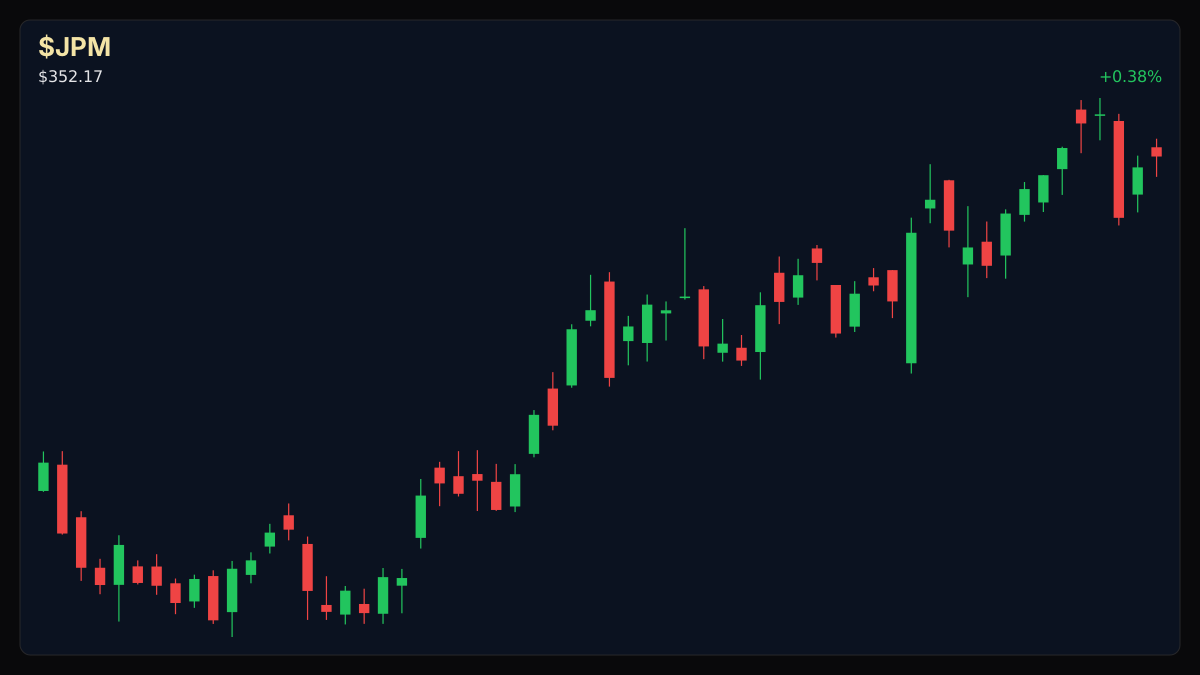
 $JPM
$JPM$JPM
TradingView
Live chart & market data via TradingView · OppHub classroom · Delayed or exchange real-time per TradingView data agreements · Not investment advice
Educational TradingView chart — search any symbol in the widget. Confirm on /markets/JPM. Not investment advice.
Related markets
Shares a vertical MP4 loop to your phone's camera roll or app share sheet (Instagram, TikTok, Facebook Reels).
Retirees with substantial portfolios, even those varying by millions of dollars, tend to spend at comparable rates, according to a recent study. Analysis of data from the Federal Reserve, JPMorgan, and Boldin indicates that households with over $1 million in net worth often align on annual spending between $70,000 and $120,000, regardless of whether their portfolio is $1.2 million or $4 million. This phenomenon suggests that once basic needs and some quality-of-life upgrades are met, additional wealth may not translate into proportionally higher consumption. Instead, wealthier retirees often focus on enhancing the quality of their spending rather than increasing the volume, leading to a plateau in overall expenditure.
### Money Play The study highlights that significant portfolio growth beyond a certain point may not yield proportional increases in consumer spending. This has implications for economic forecasting models that rely on wealth-to-spending correlations, suggesting that income and lifestyle quality might be more significant drivers of consumption among affluent retirees than absolute portfolio size.
### The Print Analysis of various datasets, including the Federal Reserve Survey of Consumer Finances, JPMorgan's retirement analysis, and Boldin's planning data, indicates that retirees with $1 million-plus portfolios typically spend between $70,000 and $120,000 annually. The median retirement income shows a modest increase of approximately $16,000 between the $1 million and $5 million-plus tiers. Data also indicates that about 50% to 54% of users with $1 million-plus portfolios have built a recurring income stream.
### Market Reaction Market data from July 31, 2026, showed broad declines across major U.S. indices, with the S&P 500 down 0.43%, the Dow Jones Industrial Average down 0.40%, and the Nasdaq 100 down 0.60%. International markets also experienced dips, with the Russell 2000 down 1.36%, the FTSE 100 down 0.96%, and the Nikkei 225 down 1.42%.
### What It Means for Policy & Positioning While this study focuses on individual retirement spending, broad trends in consumer behavior can influence overall economic demand, a factor the Federal Reserve monitors. However, the study's findings do not directly point to immediate policy shifts but rather offer insight into how wealth translates into spending patterns among a specific demographic.
### Next Calendar Watch No further specific data prints or events related to this study's findings were noted.
Read the full story
Original reporting and related coverage — attribution links only, not paid recommendations.
Trade this story
 Robinhood
 Webull
 Tradier
 IBKR
IBKR
Chart this story
 TradingView
Broker and exchange buttons use invite / refer-a-friend links (rewards may be capped). Charting links (TradingView) are partner offers that may pay OppHub America a commission at no extra cost to you.
OppSHOP
Full OppSHOP →As an Amazon Associate, OppHub America earns from qualifying purchases. Shopping here helps keep the site free — at no extra cost to you. Disclosure

OppSHOP
Related to this story
Retiree Spending Stable Across 2M-$4M Portfolios
Shop related →

Investing books
Read the classics
Shop this pick →

Personal finance books
Run the household books
Shop this pick →

Trading notebooks
Write the thesis first
Shop this pick →

Monitor for charts
See every pane
Shop this pick →
Story playbook
A pre-built map of what to watch — stocks, ETFs, and educational next steps. Not personalized advice.
Snapshot date: July 31, 2026 at 10:31 AM ET
This playbook was built when the story published and is not live-updated. Prices, news, and risk can change after this date — treat it as a starting map, not a current trade ticket.
Story → money map
retiree spending habits
A new study shows that even when retirees have millions of dollars saved, they tend to spend about the same amount of money each year. Financial analysts care about this because it helps us understand how older adults will spend their money over time.
What changed
Study findings reveal that retiree spending caps out regardless of portfolio sizes above $1 million.
Who wins / who loses
Wealth management firms benefit from steady asset retention, while luxury goods providers may see lower-than-expected spending from affluent retirees.
Time horizon
Think in terms of the next few months.
Confidence & best fit
medium confidence · Long-term investor
Safer theme exposure (ETFs)
Baskets that own the theme without betting on one company.
Single stocks (higher risk)
Primary = closest to the story · Peers = same industry · Second-order = knock-on effects · Avoid = looks related but may be a trap
Primary
- $JPMWatch — track, don’t rush
Big banks like JPMorgan track how retirees spend money to manage their wealth accounts.
View $JPM chart → · End-of-day delayed data
Peer
- $BKWatch — track, don’t rush
Financial companies that hold money for wealthy retirees could see steady business.
Options (education only)
No strikes or expiries — a framework for how traders might express the view. Options can expire worthless.
Beginners should skip options here since this is a long-term economic study rather than a fast-moving stock event.
See options-friendly brokers →Income / OppHub America angle
Not a trade tip — ways to use the insight outside the market.
- Focus on financial planning services catering to high-net-worth individuals prioritizing quality over volume
What would break this thesis
- Macroeconomic shocks that drastically alter retiree net worth or inflation rates forcing higher spending needs
What to do next on OppHub America
Saved playbooks stay on this device for now.
Important
Not financial advice. OppHub America playbooks are educational market maps only — not recommendations to buy, sell, or hold any security. Markets move fast; information can be wrong or outdated. Trade and invest at your own risk. Do your own research or consult a licensed advisor.
Based on reporting from yahoo-megacap-tickers.
Informational and educational only — not investment, financial, or legal advice. Disclosure
Shares a vertical MP4 loop to your phone's camera roll or app share sheet (Instagram, TikTok, Facebook Reels).