Barry, OppHub America Desk · · Source: yahoo-tickers-tape-movers
Walmart's Q2 Analyst Call: Sustaining Price Amid Macro Headwinds
If macroeconomic pressures continue to affect consumer spending, watch Walmart for its strategic responses to tariff impacts and fuel prices, as these factors directly influence its operational costs and market share. Observing Walmart's e-commerce and membership growth could indicate its ability to adapt to changing consumer behaviors and competitive landscapes.
Based on reporting from yahoo-tickers-tape-movers.
Walmart's Q2 earnings call on Thursday, August 27, 2026, highlighted analyst concerns regarding the sustainability of its pricing strategy amidst macroeconomic pressures, despite the company exceeding revenue and adjusted EPS estimates. Investors are scrutinizing how Walmart plans to maintain market share gains given ongoing investments in pricing and a challenging consumer environment.
Market context for this story
As of: After HoursLoading quotes…
Informational only — not investment advice. Full markets →


$WMTWalmart
TradingView
Live chart & market data via TradingView · OppHub classroom · Delayed or exchange real-time per TradingView data agreements · Not investment advice
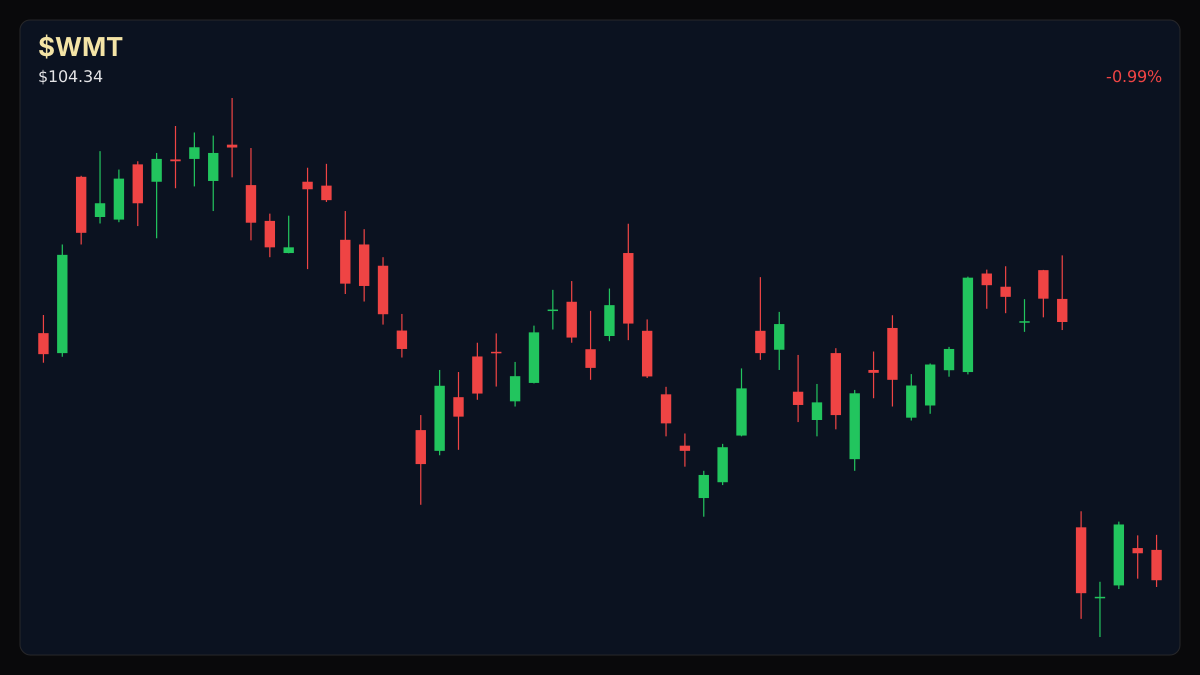
Educational TradingView chart — search any symbol in the widget. Confirm on /markets/WMT and related $NVDA, $CRM. Not investment advice.
Related markets
Shares a vertical MP4 loop to your phone's camera roll or app share sheet (Instagram, TikTok, Facebook Reels).
Walmart (NYSE: WMT) surpassed Q2 2026 revenue and adjusted earnings per share (EPS) estimates, reporting revenue of $187.9 billion against an estimated $186.8 billion, marking a 0.6% beat and 5.9% year-on-year growth. Adjusted EPS reached $0.81, beating analyst estimates of $0.74 by 9.3%. Despite these figures, management's Q3 CY2026 revenue guidance of $185.6 billion at the midpoint fell below analyst expectations of $188.3 billion. The company raised its full-year adjusted EPS guidance to $2.84 at the midpoint, a 1.3% increase, and maintained an operating margin of 5%, consistent with the prior year.
However, analyst questions during the earnings call focused on key strategic and macroeconomic challenges. Goldman Sachs inquired about Walmart's ability to sustain lower prices once tariff refunds are exhausted. CEO John Furner indicated that price investments are strategically managed for return and are intended to be permanent where they contribute to market share gains.
Morgan Stanley raised concerns about the impact of higher fuel prices on lower-income consumers and the lagged benefits of price rollbacks. CFO Rainey clarified that while unit growth is immediate, the full sales impact accumulates over time. Evercore ISI questioned future tariff rates and operating income growth, with Rainey stating that assumptions are based on current tariff and fuel levels and that platform businesses are increasingly driving profit growth.
### Story Arc / How We Got Here Walmart's Q2 earnings discussion follows a period of persistent macroeconomic pressures impacting consumer spending, a trend observed in other discretionary sectors. For instance, Comptoir Group reported a 0.7% decline in like-for-like revenue for the first half of 2026 due to economic uncertainty, as detailed in our prior coverage at /explore/comptoir-group-revenue-falls-0-7-on-consumer-pressures. Walmart's focus on price investments and platform businesses indicates a strategic response to these broader economic headwinds.
### Tape / Session Read In the broader market, several technology and growth stocks experienced notable movements. Nvidia (NASDAQ: NVDA) saw a decrease of 1.59% to $209.66. Salesforce, Inc. (NYSE: CRM) closed up 5.07% at $206.09, while CrowdStrike Holdings, Inc. (NASDAQ: CRWD) increased by 2.05%. Among other significant movers, Abercrombie & Fitch Co. (NYSE: ANF) surged 35.67%, and Biohaven Ltd. (NYSE: BHVN) rose 17.87%.
### Why This Lane Matters Walmart's Q2 performance and analyst discussions offer insight into consumer resilience and corporate strategy in a fluctuating economic landscape. The focus on price sustainability and the impact of external factors like tariffs and fuel costs on its diverse consumer base underscore critical themes for investors evaluating the retail sector and broader economic sentiment.
## $WMT+WL Technical Analysis & Key Risk Watch
Walmart's financial health, as evidenced by consistent operating margins and increased EPS guidance, provides a defensive posture in the retail sector. Key investor focus will remain on the long-term efficacy of its pricing strategies and the ability of its platform businesses to offset macroeconomic pressures on traditional retail sales. While specific price levels for $WMT+WL were not provided in the market context, investors will monitor any future disclosures for indications of technical support or resistance.
Read the full story
Original reporting and related coverage — attribution links only, not paid recommendations.
Trade this story
 Robinhood
 Webull
 Tradier
 IBKR
IBKR
Chart this story
 TradingView
Broker and exchange buttons use invite / refer-a-friend links (rewards may be capped). Charting links (TradingView) are partner offers that may pay OppHub America a commission at no extra cost to you.
OppSHOP
Full OppSHOP →As an Amazon Associate, OppHub America earns from qualifying purchases. Shopping here helps keep the site free — at no extra cost to you. Disclosure

OppSHOP
Related to this story
If macroeconomic pressures continue to affect consumer spending, watch W
Shop related →

Investing books
Read the classics
Shop this pick →

Personal finance books
Run the household books
Shop this pick →

Trading notebooks
Write the thesis first
Shop this pick →

Monitor for charts
See every pane
Shop this pick →
Story playbook
A pre-built map of what to watch — stocks, ETFs, and educational next steps. Not personalized advice.
Snapshot date: August 27, 2026 at 4:56 AM ET
This playbook was built when the story published and is not live-updated. Prices, news, and risk can change after this date — treat it as a starting map, not a current trade ticket.
Story → money map
retail pricing and consumer spending
Walmart made more money than expected last quarter, but warned that future sales might grow a bit slower because shoppers are feeling squeezed. Wall Street is watching to see if Walmart can keep its prices low and still make a profit.
What changed
Walmart reported a Q2 earnings beat alongside slightly soft Q3 revenue guidance and ongoing questions about maintaining low prices.
Who wins / who loses
Value-focused retail giants benefit as budget-conscious shoppers trade down, while traditional department stores and smaller discount retailers face margin pressure.
Time horizon
Think in terms of the next few months.
Confidence & best fit
medium confidence · Long-term investor
Safer theme exposure (ETFs)
Baskets that own the theme without betting on one company.
Single stocks (higher risk)
Primary = closest to the story · Peers = same industry · Second-order = knock-on effects · Avoid = looks related but may be a trap
Primary
- $WMTWatch — track, don’t rush
The main company in the news; we want to see if their low-price strategy keeps bringing in shoppers.
View $WMT chart → · End-of-day delayed data
Peer
- $TGTWatch — track, don’t rush
A major competitor that will show us if shoppers are pulling back on non-essential items.
View $TGT chart → · End-of-day delayed data
- $COSTBuild slowly — only if it fits your plan
A warehouse club that makes steady money from membership fees, helping them weather tough economic times.
View $COST chart → · End-of-day delayed data
Avoid / trap
- $DGStay away — for now
A dollar store chain that caters to lower-income shoppers, who are currently feeling the most financial pain.
View $DG chart → · End-of-day delayed data
Options (education only)
No strikes or expiries — a framework for how traders might express the view. Options can expire worthless.
Direction: range · Style: Covered-call income (only if you already own shares) · Level: intermediate
Beginners should skip options here; stick to simply owning the stock if you want to invest.
Income / OppHub America angle
Not a trade tip — ways to use the insight outside the market.
- Shop at Walmart using cash-back credit cards that reward grocery and wholesale club purchases to offset inflation.
What would break this thesis
- Unexpected spikes in inflation or tariffs that severely erode retail operating margins across the sector.
What to do next on OppHub America
Saved playbooks stay on this device for now.
Important
Not financial advice. OppHub America playbooks are educational market maps only — not recommendations to buy, sell, or hold any security. Markets move fast; information can be wrong or outdated. Trade and invest at your own risk. Do your own research or consult a licensed advisor.
Aftermath · $NVDA
+8.76% vs write
- •Since this piece: $NVDA is up +8.76% vs $208.48 at write time (now $226.74).
- •Session move (Yahoo delayed): +8.15%.
- •RSI14 at write was 46 — compare levels on Markets, not advice.
- •Original money play lens: If macroeconomic pressures continue to affect consumer spending, watch Walmart for its strategic responses to tariff impacts and fuel prices, as these factors directly influence it
- •Track $NVDA live on OppHub Markets (/markets/NVDA). Not financial advice.
Based on reporting from yahoo-tickers-tape-movers.
Informational and educational only — not investment, financial, or legal advice. Disclosure
Shares a vertical MP4 loop to your phone's camera roll or app share sheet (Instagram, TikTok, Facebook Reels).