Barry, OppHub America Desk · · Source: yahoo-tickers-rotation
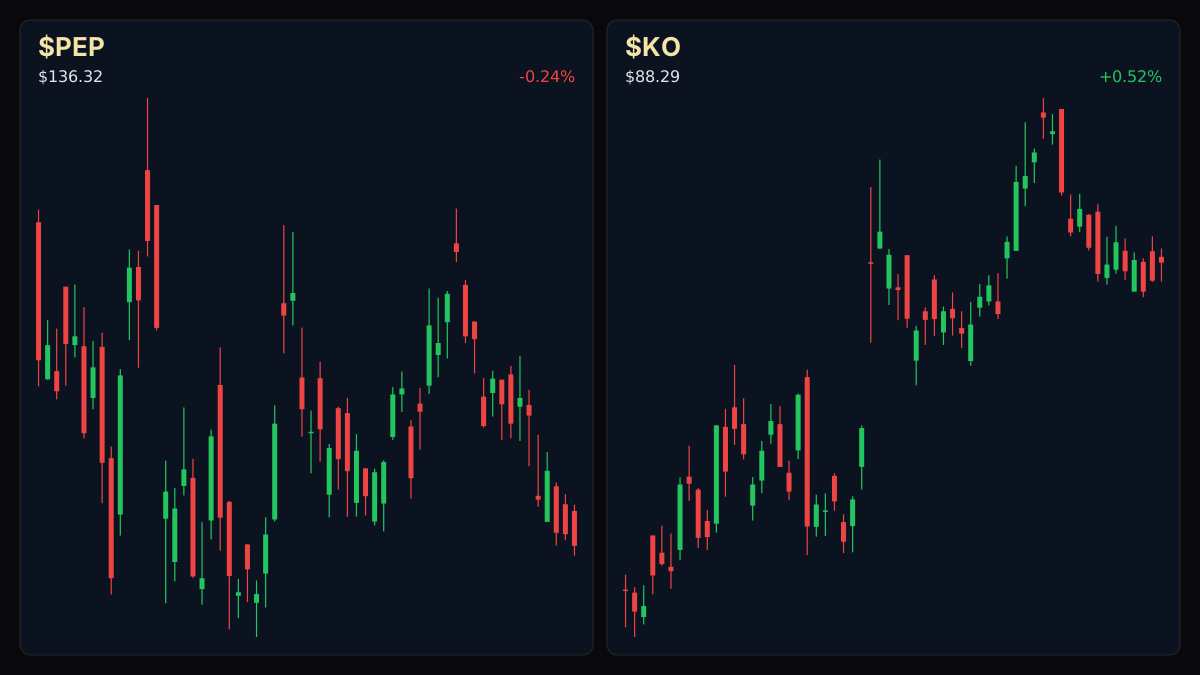
Coca-Cola Outpaces Pepsi in 5-Year Return Amidst Margin Strengths
* Investors favoring a cleaner business model and higher margins may find Coca-Cola's performance compelling. * For income-focused investors, while PepsiCo offers a long dividend increase streak, Coca-Cola's more tightly covered dividend may present a more secure option.
Based on reporting from yahoo-tickers-rotation.
Coca-Cola (KO) has delivered an 84% five-year return, significantly outperforming PepsiCo's (PEP) 3% due to its concentrate business model which yields higher gross and operating margins. While PepsiCo offers a long dividend history, Coca-Cola's stronger margins and raised guidance present a more defensible premium valuation.
Market context for this story
As of: WeekendLoading quotes…
Informational only — not investment advice. Full markets →


$PEPPepsiCo
TradingView
Live chart & market data via TradingView · OppHub classroom · Delayed or exchange real-time per TradingView data agreements · Not investment advice
Educational TradingView chart — search any symbol in the widget. Confirm on /markets/PEP and related $KO. Not investment advice.
Related markets
Shares a vertical MP4 loop to your phone's camera roll or app share sheet (Instagram, TikTok, Facebook Reels).
Coca-Cola (KO) has significantly outperformed PepsiCo (PEP) over the past five years, generating an 84% return compared to PepsiCo's 3%. This divergence is largely attributed to Coca-Cola's concentrate business model, which offloads capital intensity to bottlers and results in higher gross margins of 61.6% versus PepsiCo's 54.1%, and operating margins of 28.7% compared to PepsiCo's 14.4%.
Coca-Cola recently reported its fifth consecutive earnings per share beat, with adjusted EPS of $0.97 on revenue up 6.7% year-over-year. The company also raised its fiscal year 2026 organic revenue guidance to approximately 5%, driven by a 5% increase in global unit case volume and a 16% rise in Coca-Cola Zero Sugar. This performance, coupled with a 34.9% operating margin, supports its premium valuation.
PepsiCo's results presented a mixed picture. Revenue grew 6.4% year-over-year to $24.181 billion with core EPS of $2.20. However, its North America Foods division saw a 2% decline due to softer net pricing, and its core operating margin contracted. Growth was primarily driven by international segments, such as Latin America Foods, which rose 15%, and EMEA, up 10%.
Despite a 54th consecutive annual dividend increase and a 4.21% yield, PepsiCo's dividend payout coverage is noted as tight against its earnings per share. Coca-Cola's earnings per share of $7.63 cover its $5.75 dividend, offering a more secure income appeal. The market has favored Coca-Cola's leaner business model, which has supported its stock performance.
### Story Arc / How We Got Here
Coca-Cola's stock performance has been a subject of investor interest, particularly in comparison to its beverage rival PepsiCo. In prior coverage on September 6, 2026, the focus was on Coca-Cola's stock performance, examining whether it was a buy, sell, or hold. At that time, Coca-Cola was noted for its consistent dividend growth and solid organic revenue expansion. The current analysis builds on this by detailing the diverging five-year stock returns and highlighting the structural business model differences that explain this performance gap. Investors continue to evaluate the income and growth prospects of both companies, with Coca-Cola's strong margins and guidance currently differentiating it from PepsiCo's more complex operational landscape.
### Story Arc / How We Got Here
This follows our earlier coverage ([Coca-Cola Stock Performance: Buy, Sell, or Hold?](/explore/coca-cola-stock-performance-buy-sell-or-hold)) on 2026-09-06. Coca-Cola (KO) shares have surged 28% over the past year, significantly outperforming the consumer staples average (5%) and the S&P 500 (20%). This impressive run prompts investors to evaluate whether the stock remains a buy, hold, or sell. The company's consistent dividend growth and solid organic revenue expansion offer underlying support for its valuation. · Investors seeking income may find Coca-Cola's 2.4% dividend yield attractive, especially following its recent stock performance and consistent dividend growth.
Read the full story
Original reporting and related coverage — attribution links only, not paid recommendations.
Trade this story
 Robinhood
 Webull
 Tradier
 IBKR
IBKR
Chart this story
 TradingView
Broker and exchange buttons use invite / refer-a-friend links (rewards may be capped). Charting links (TradingView) are partner offers that may pay OppHub America a commission at no extra cost to you.
OppSHOP
Full OppSHOP →As an Amazon Associate, OppHub America earns from qualifying purchases. Shopping here helps keep the site free — at no extra cost to you. Disclosure

OppSHOP
Related to this story
* Investors favoring a cleaner business model and higher margins may fin
Shop related →

Investing books
Read the classics
Shop this pick →

Personal finance books
Run the household books
Shop this pick →

Trading notebooks
Write the thesis first
Shop this pick →

Monitor for charts
See every pane
Shop this pick →
Story playbook
A pre-built map of what to watch — stocks, ETFs, and educational next steps. Not personalized advice.
Snapshot date: September 13, 2026 at 8:25 PM ET
This playbook was built when the story published and is not live-updated. Prices, news, and risk can change after this date — treat it as a starting map, not a current trade ticket.
Story → money map
consumer staples margins
Coca-Cola is making much more profit than PepsiCo because it sells syrup concentrate instead of running heavy bottling factories. Money managers like Coca-Cola better right now because its profits are safer and growing faster.
What changed
Coca-Cola reported strong earnings and raised guidance, highlighting a massive five-year performance lead over rival PepsiCo.
Who wins / who loses
Coca-Cola benefits from higher margins and investor favor, while PepsiCo lags due to lower operating margins and tight dividend coverage.
Time horizon
Think in terms of the next few months.
Confidence & best fit
high confidence · Long-term investor, Side income / builder
Safer theme exposure (ETFs)
Baskets that own the theme without betting on one company.
Single stocks (higher risk)
Primary = closest to the story · Peers = same industry · Second-order = knock-on effects · Avoid = looks related but may be a trap
Primary
- $KOBuild slowly — only if it fits your plan
Coca-Cola makes more money on every dollar of sales because it avoids the heavy costs of running factories.
View $KO chart → · End-of-day delayed data
Peer
- $PEPWatch — track, don’t rush
PepsiCo has higher costs and lower profit margins right now, making its high dividend payment harder to maintain.
View $PEP chart → · End-of-day delayed data
Second-order
- $KDPWatch — track, don’t rush
Keurig Dr Pepper is another drink maker that moves up and down when investors look at the beverage industry.
View $KDP chart → · End-of-day delayed data
Options (education only)
No strikes or expiries — a framework for how traders might express the view. Options can expire worthless.
Direction: bullish · Style: Covered-call income (only if you already own shares) · Level: intermediate
Beginners should skip options; if you already own Coca-Cola shares, you can sell the right for someone else to buy them from you at a higher price to collect extra cash.
Income / OppHub America angle
Not a trade tip — ways to use the insight outside the market.
- Review your dividend portfolio allocation to ensure payout ratios are comfortably covered by earnings.
What would break this thesis
- Sudden shift in consumer preferences away from carbonated beverages or severe input cost inflation squeezing margins.
What to do next on OppHub America
Saved playbooks stay on this device for now.
Important
Not financial advice. OppHub America playbooks are educational market maps only — not recommendations to buy, sell, or hold any security. Markets move fast; information can be wrong or outdated. Trade and invest at your own risk. Do your own research or consult a licensed advisor.
Based on reporting from yahoo-tickers-rotation.
Informational and educational only — not investment, financial, or legal advice. Disclosure
Shares a vertical MP4 loop to your phone's camera roll or app share sheet (Instagram, TikTok, Facebook Reels).