OppHub America Desk · · Source: yahoo-tickers-rotation
Financial Sector Shifts to AI Authorization Amid Federal Vacuum
Investors should monitor private ordering protocols and consortium developments within financial technology sectors.
Based on reporting from yahoo-tickers-rotation.
Major financial institutions are transitioning from blanket blocks on autonomous software to developing structured authorization layers as legislative efforts remain stalled. Announced on October 6, 2026, and October 15, 2026, new cryptographic protocols like Poppy and Proof x401 address liability and identity gaps in agentic commerce.
Market context for this story
As of: WeekendLoading quotes…
Informational only — not investment advice. Full markets →
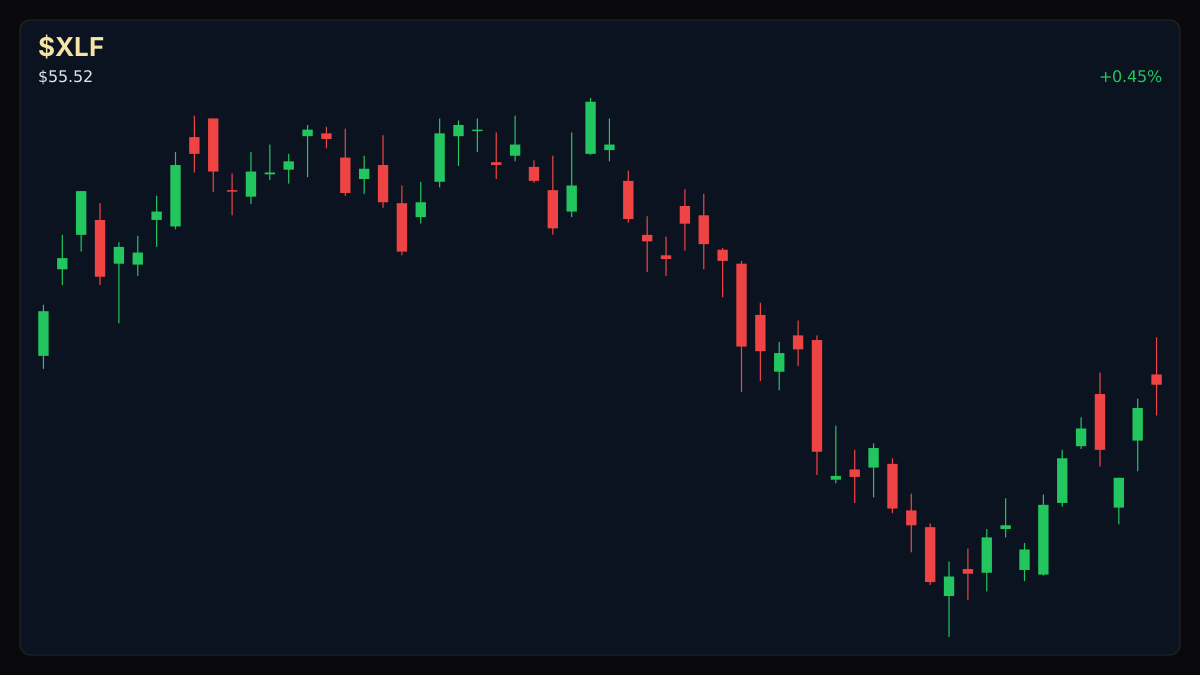
 Financial Select Sector·$XLF
$XLFFinancial Select Sector
TradingView
Live chart & market data via TradingView · OppHub classroom · Delayed or exchange real-time per TradingView data agreements · Not investment advice
Educational TradingView chart — search any symbol in the widget. Confirm on /markets/XLF. Not investment advice.
Related markets
Shares a vertical MP4 loop to your phone's camera roll or app share sheet (Instagram, TikTok, Facebook Reels).
Financial institutions are moving away from defensive binary blocks toward structured authorization frameworks for autonomous software, driven by a lack of federal guidance and stalled legislative efforts like the Warner AI AGENT Act. Major firms are confronting acute liability concerns regarding autonomous agents accessing client accounts without adequate controls.
### The Consortium Approach: Poppy
Announced at the Sierra Summit on October 6, 2026, Poppy—the Personal Agent Protocol—establishes a collaborative standard for agent-business interactions. With 42 design partners including Bank of America, Wells Fargo, Visa, Mastercard, PayPal, Stripe, Plaid, and BBVA, the protocol utilizes OAuth-based session authorization to replace all-or-nothing access models with granular spectrums of control.
### Cryptographic Mandate: Proof x401
Announced on October 15, 2026, Proof x401 addresses identity verification by extending standard HTTP 401 responses to request verified identity and signed mandates. The protocol establishes a four-node delegation chain involving a verified human, a signed mandate, an agent presenting via OpenID4VP, and independent merchant verification.
### Private Ordering as Policy
In the absence of statutory frameworks from federal regulators or the Department of Justice, private sector coalitions are establishing the baseline rules for the agentic economy. These authorization layers ensure that the entity behind an autonomous agent is known and authenticated across cross-channel interactions.
Read the full story
Original reporting and related coverage — attribution links only, not paid recommendations.
Trade this story (crypto)
 Coinbase
 Gemini
 Robinhood
 Webull
Chart this story
 TradingView
Broker and exchange buttons use invite / refer-a-friend links (rewards may be capped). Charting links (TradingView) are partner offers that may pay OppHub America a commission at no extra cost to you.
OppSHOP
Full OppSHOP →As an Amazon Associate, OppHub America earns from qualifying purchases. Shopping here helps keep the site free — at no extra cost to you. Disclosure

OppSHOP
Related to this story
Investors should monitor private ordering protocols and consortium devel
Shop related →

Investing books
Read the classics
Shop this pick →

Personal finance books
Run the household books
Shop this pick →

Trading notebooks
Write the thesis first
Shop this pick →

Monitor for charts
See every pane
Shop this pick →
Based on reporting from yahoo-tickers-rotation.
Informational and educational only — not investment, financial, or legal advice. Disclosure
Shares a vertical MP4 loop to your phone's camera roll or app share sheet (Instagram, TikTok, Facebook Reels).