OppHub America Desk · · Source: yahoo-megacap-tickers
Global Rates Climb: Threat to Bonds Beyond the Fed
The increasing divergence in global interest rate policies means that investors relying on bonds for portfolio stability may face higher volatility and reduced diversification benefits. Traders might observe potential shifts in currency valuations as international central banks adjust rates independently of the Federal Reserve.
Based on reporting from yahoo-megacap-tickers.
Global government bonds are facing increasing pressure from rising interest rates outside the U.S., with some markets experiencing significant losses. This trend, driven by factors beyond Federal Reserve policy, is prompting investors to reconsider traditional portfolio diversification strategies, particularly concerning fixed income.
Market context for this story
As of: WeekendLoading quotes…
Informational only — not investment advice. Full markets →
 SPDR S&P 500 ETF·$SPY
 Invesco QQQ Trust·$QQQ
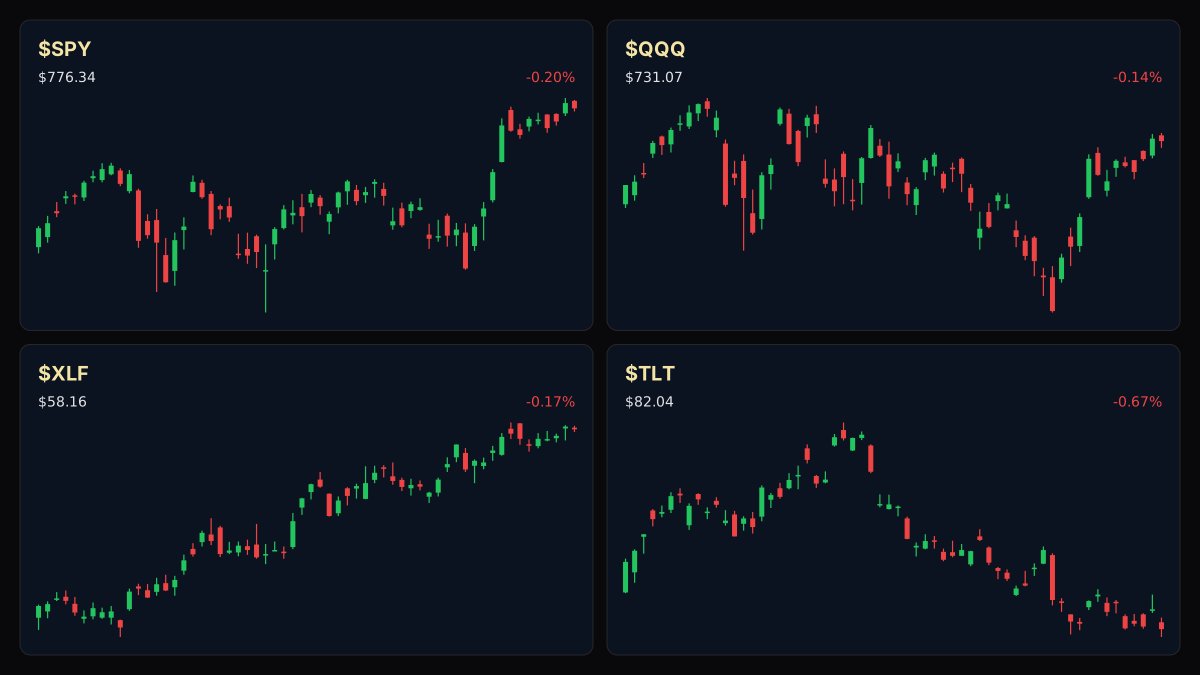
 iShares 20+ Year Treasury·$TLT
 Financial Select Sector·$XLF
$SPYSPDR S&P 500 ETF
TradingView
Live chart & market data via TradingView · OppHub classroom · Delayed or exchange real-time per TradingView data agreements · Not investment advice
$QQQInvesco QQQ Trust
TradingView
Live chart & market data via TradingView · OppHub classroom · Delayed or exchange real-time per TradingView data agreements · Not investment advice
Educational TradingView charts — search any symbol in the widget. Confirm on /markets/SPY and related $QQQ, $TLT, $XLF. Not investment advice.
Related markets
Shares a vertical MP4 loop to your phone's camera roll or app share sheet (Instagram, TikTok, Facebook Reels).
Rising global interest rates, notably outside the Federal Reserve's direct influence, are challenging the conventional role of bonds as portfolio stabilizers, with South Korean government debt losing over 9% and Japanese bonds down approximately 4% in local currency terms this year. The phenomenon, observed on Sunday, August 16, 2026, suggests a re-evaluation of fixed-income strategies by investors.
### Money Play Given the shifting dynamics in global fixed-income markets, investors should be aware that traditional bond diversification strategies may be less effective in mitigating risk, particularly as central banks outside the U.S. pursue tighter monetary policies.
### Executive Thesis The current environment indicates that central banks globally are responding to a complex mix of elevated oil prices, increased government spending, and an AI-driven economic surge, leading to higher inflation and more aggressive rate hike expectations. This diverges from a Fed-centric rate cycle, putting pressure on bonds and potentially impacting richly valued equities by compressing future earnings' present value.
### The Print South Korean government debt has recorded a loss exceeding 9% in local currency terms this year. Japanese bonds have also seen a decline, down approximately 4% over the same period. These figures highlight significant pressure in global fixed-income markets.
### Market Reaction Market expectations indicate that borrowing costs are anticipated to rise faster in several international markets—including Japan, Canada, the UK, and the Eurozone—compared to the U.S. over the next year. Two-thirds of the 32 swap markets tracked globally are pricing in rate hikes, with South Korea leading at over 100 basis points.
### What It Means for Policy & Positioning The global tightening cycle is influenced by factors such as persistent inflation, driven by higher energy costs and significant fiscal stimulus. This suggests that central banks may be compelled to maintain or increase rates independently of the Fed's actions, altering the landscape for monetary policy and investment positioning, particularly for assets sensitive to interest rate changes.
### Next Calendar Watch Investors should monitor upcoming inflation and employment data releases from major global economies, as these are key inputs for central bank policy decisions regarding interest rates.
### Story Arc / How We Got Here This development contrasts with recent U.S. labor market trends. Earlier, on August 7, 2026, the U.S. experienced an unexpected contraction of 23,000 jobs, as detailed in our prior coverage at /explore/unemployment-rate-holds-steady-4-1-percent-sp500-rises-0-6-percent. While the U.S. employment picture pointed to potential moderation, the current global bond market stress indicates that international monetary policy drivers are now distinct and potent forces on their own.
Read the full story
Original reporting and related coverage — attribution links only, not paid recommendations.
Trade this story
 Robinhood
 Webull
 Tradier
 IBKR
IBKR
Chart this story
 TradingView
Broker and exchange buttons use invite / refer-a-friend links (rewards may be capped). Charting links (TradingView) are partner offers that may pay OppHub America a commission at no extra cost to you.
OppSHOP
Full OppSHOP →As an Amazon Associate, OppHub America earns from qualifying purchases. Shopping here helps keep the site free — at no extra cost to you. Disclosure

OppSHOP
Related to this story
The increasing divergence in global interest rate policies means that in
Shop related →

Investing books
Read the classics
Shop this pick →

Personal finance books
Run the household books
Shop this pick →

Trading notebooks
Write the thesis first
Shop this pick →

Monitor for charts
See every pane
Shop this pick →
Based on reporting from yahoo-megacap-tickers.
Informational and educational only — not investment, financial, or legal advice. Disclosure
Shares a vertical MP4 loop to your phone's camera roll or app share sheet (Instagram, TikTok, Facebook Reels).