Barry, OppHub America Desk · · Source: yahoo-tickers-tape-movers
VGLT vs. TLT: Bond ETF Value Comparison
Investors seeking lower costs in long-term Treasury exposure may find 's 0.03% expense ratio more appealing than 's 0.15%.
Based on reporting from yahoo-tickers-tape-movers.
Long-term Treasury ETFs VGLT and TLT saw price gains of 1.50% and 1.67% respectively. Investors weighing these bond funds may find VGLT's lower expense ratio of 0.03% more attractive than TLT's 0.15%.
Market context for this story
As of: Regular HoursLoading quotes…
Informational only — not investment advice. Full markets →

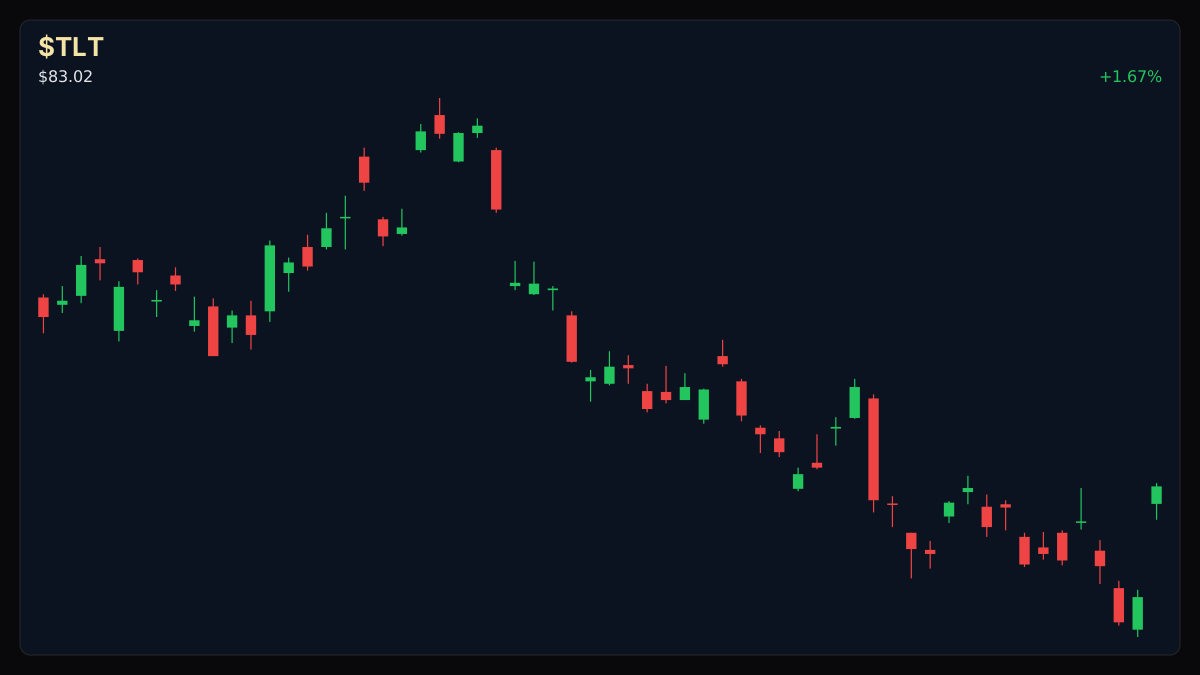
$TLTiShares 20+ Year Treasury
TradingView
Live chart & market data via TradingView · OppHub classroom · Delayed or exchange real-time per TradingView data agreements · Not investment advice
Educational TradingView chart — search any symbol in the widget. Confirm on /markets/TLT. Not investment advice.
Related markets
Shares a vertical MP4 loop to your phone's camera roll or app share sheet (Instagram, TikTok, Facebook Reels).
The Vanguard Long-Term Treasury ETF (VGLT) and iShares 20+ Year Treasury Bond ETF ($TLT+WL) both advanced, showing 1.50% and 1.67% gains, respectively. Investors scrutinizing long-duration bond exposure may favor VGLT due to its significantly lower expense ratio of 0.03% compared to $TLT+WL's 0.15%.
While both ETFs offer exposure to long-dated government debt, VGLT tracks bonds with maturities between 10 and 25 years, holding approximately 100 securities. Its top holdings include U.S. Treasury Notes with coupon rates around 4.75%. $TLT+WL, conversely, targets the ultra-long end of the curve, holding 48 securities with maturities exceeding 20 years, with key holdings featuring Treasury Bonds around 4.53% and 4.47% yields.
The Vanguard fund, launched in 2009, reported a trailing-12-month dividend of $2.52 per share, yielding 4.75% at its recent price. The iShares fund, launched in 2002, paid $3.90 per share over the same period, yielding 4.72% at its recent price. In terms of risk, $TLT+WL experienced a 5-year max drawdown of -43.8%, while VGLT saw a -41.0% drawdown over the same period. For every $1,000 invested, VGLT generated $703 in total return over five years, compared to $658 for $TLT+WL.
Read the full story
Original reporting and related coverage — attribution links only, not paid recommendations.
Trade this story
 Robinhood
 Webull
 Tradier
 IBKR
IBKR
Chart this story
 TradingView
Broker and exchange buttons use invite / refer-a-friend links (rewards may be capped). Charting links (TradingView) are partner offers that may pay OppHub America a commission at no extra cost to you.
OppSHOP
Full OppSHOP →As an Amazon Associate, OppHub America earns from qualifying purchases. Shopping here helps keep the site free — at no extra cost to you. Disclosure

OppSHOP
Related to this story
Investors seeking lower costs in long-term Treasury exposure may find 's
Shop related →

Investing books
Read the classics
Shop this pick →

Personal finance books
Run the household books
Shop this pick →

Trading notebooks
Write the thesis first
Shop this pick →

Monitor for charts
See every pane
Shop this pick →
Story playbook
A pre-built map of what to watch — stocks, ETFs, and educational next steps. Not personalized advice.
Snapshot date: August 19, 2026 at 4:58 PM ET
This playbook was built when the story published and is not live-updated. Prices, news, and risk can change after this date — treat it as a starting map, not a current trade ticket.
Story → money map
Long-Term Treasuries
Long-term government bond funds went up in price. Investors are choosing the cheaper option to save on fees over time.
What changed
Long-term Treasury ETFs rose in value, prompting a cost comparison between low-fee VGLT and higher-fee TLT.
Who wins / who loses
Cost-conscious bond investors win through lower fees, while higher-cost funds face competitive pressure.
Time horizon
Think in terms of the next few months.
Confidence & best fit
high confidence · Long-term investor
Safer theme exposure (ETFs)
Baskets that own the theme without betting on one company.
Single stocks (higher risk)
Primary = closest to the story · Peers = same industry · Second-order = knock-on effects · Avoid = looks related but may be a trap
Primary
- $VGLTBuild slowly — only if it fits your plan
A low-cost fund holding U.S. government bonds that lets you keep more of your investment returns.
Peer
- $TLTWatch — track, don’t rush
A popular, older government bond fund that costs a bit more to own than its competitors.
View $TLT chart → · End-of-day delayed data
Second-order
- $IEFWatch — track, don’t rush
A medium-term government bond fund that is usually less bouncy than ultra-long bonds.
Options (education only)
No strikes or expiries — a framework for how traders might express the view. Options can expire worthless.
Beginners should skip options here and just buy the bonds or ETFs directly for income.
See options-friendly brokers →Income / OppHub America angle
Not a trade tip — ways to use the insight outside the market.
- Review existing brokerage fee structures on fixed-income holdings to minimize drag.
What would break this thesis
- Unexpected spikes in inflation causing long-term bond yields to surge and bond prices to drop.
What to do next on OppHub America
Saved playbooks stay on this device for now.
Important
Not financial advice. OppHub America playbooks are educational market maps only — not recommendations to buy, sell, or hold any security. Markets move fast; information can be wrong or outdated. Trade and invest at your own risk. Do your own research or consult a licensed advisor.
Based on reporting from yahoo-tickers-tape-movers.
Informational and educational only — not investment, financial, or legal advice. Disclosure
Shares a vertical MP4 loop to your phone's camera roll or app share sheet (Instagram, TikTok, Facebook Reels).