Barry, OppHub America Desk · · Source: yahoo-tickers-tape-movers
CoreWeave Liability Strain Highlights AI Boom Financing Risk
If debt servicing costs and capital expenditure burn rates outpace open credit market liquidity, watch because balance sheet vulnerability directly magnifies downside risk during broader sector valuation adjustments. If hardware demand breadth remains robust despite tightening credit conditions, watch $NVDA+WL because established chipmakers with strong free cash flow insulate against downstream financing bottlenecks.
Based on reporting from yahoo-tickers-tape-movers.
CoreWeave (NASDAQ:CRWV) faces intense balance-sheet scrutiny as soaring debt costs collide with massive capital expenditure demands ahead of Anthropic's reported $1.5 trillion IPO ambitions. Institutional investors are weighing whether high-cash-burn infrastructure providers can sustain leverage as credit markets tighten.
Market context for this story
As of: WeekendLoading quotes…
Informational only — not investment advice. Full markets →


$XLKTechnology Select Sector
TradingView
Live chart & market data via TradingView · OppHub classroom · Delayed or exchange real-time per TradingView data agreements · Not investment advice
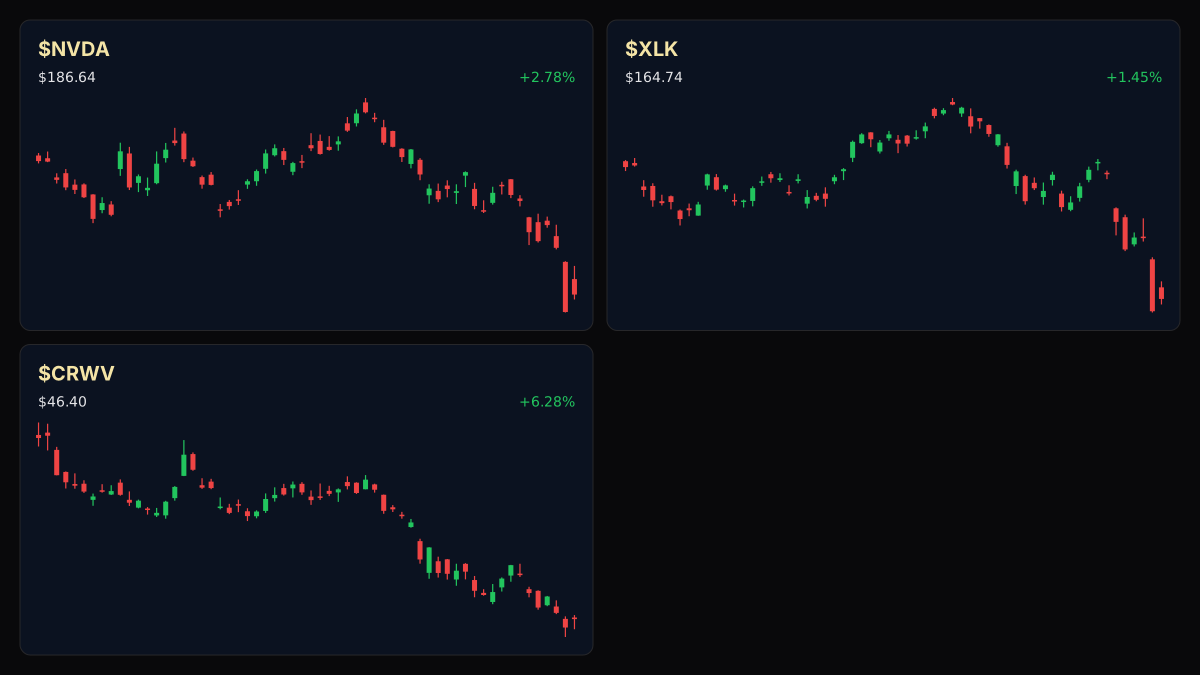
Educational TradingView chart — search any symbol in the widget. Confirm on /markets/XLK and related $NVDA, $CRWV. Not investment advice.
Related markets
Shares a vertical MP4 loop to your phone's camera roll or app share sheet (Instagram, TikTok, Facebook Reels).
CoreWeave (NASDAQ:CRWV) shares closed at $46.40 on November 6, marking a 47.54% decline over one month and a 56.61% drop over the past year as market participants scrutinize debt-fueled data center buildouts. As Anthropic targets an $80 billion to $100 billion valuation at roughly $1.5 trillion, the massive financing test highlights divergent capital structures across the artificial intelligence sector, where infrastructure providers absorb soaring interest obligations while upstream hardware suppliers generate robust free cash flow.
### Tape / Session Read & Balance Sheet Realities
CoreWeave carried $72.05 billion in total liabilities against $5.02 billion in shareholders' equity at the end of the second quarter of 2026. With a debt-to-equity ratio of 8.94 and net debt to EBITDA at 10.75, operating income remains insufficient to cover interest expenses. Second-quarter interest expense reached $640 million—up from $267 million a year prior—while management guided third-quarter interest to a range of $860 million to $940 million. Free cash flow for the second quarter stood at -$5.743 billion, bridged by $10.071 billion in financing cash as full-year 2026 capital expenditure guidance targets $35 billion.
### Story Arc / How We Got Here
Today's financing strain and leverage concerns build upon rapid infrastructure expansion cycles previously tracked in our coverage of Nvidia partner ecosystems, where surging data center demand pushed organic order books higher but intensified the need for sustainable capital access (see our prior analysis at /explore/nvidia-partner-orders-double-as-ai-infrastructure-demand-accelerates). While hardware suppliers like NVIDIA (NASDAQ:NVDA) report substantial quarterly free cash flow and minimal debt, heavily leveraged operators remain acutely sensitive to credit market conditions.
### Money Play
- If debt servicing costs and capital expenditure burn rates outpace open credit market liquidity, watch $CRWV+WL because balance sheet vulnerability directly magnifies downside risk during broader sector valuation adjustments. - If hardware demand breadth remains robust despite tightening credit conditions, watch $NVDA+WL because established chipmakers with strong free cash flow insulate against downstream financing bottlenecks.
### Why This Lane Matters
The tension between leveraged infrastructure providers and cash-positive hardware titans dictates risk appetite across the broader technology sector. When high-yield debt burdens collide with multi-billion-dollar capex schedules, capital rotation often accelerates away from overleveraged balance sheets toward firms with resilient liquidity buffers.
### Related Names
## $NVDA+WL Technical Analysis & Key Risk Watch — LIVE MARKET CONTEXT
Read the full story
Original reporting and related coverage — attribution links only, not paid recommendations.
Trade this story (crypto)
 Coinbase
 Gemini
 Robinhood
 Webull
Chart this story
 TradingView
Broker and exchange buttons use invite / refer-a-friend links (rewards may be capped). Charting links (TradingView) are partner offers that may pay OppHub America a commission at no extra cost to you.
OppSHOP
Full OppSHOP →As an Amazon Associate, OppHub America earns from qualifying purchases. Shopping here helps keep the site free — at no extra cost to you. Disclosure

OppSHOP
Related to this story
If debt servicing costs and capital expenditure burn rates outpace open
Shop related →

Investing books
Read the classics
Shop this pick →

Personal finance books
Run the household books
Shop this pick →

Trading notebooks
Write the thesis first
Shop this pick →

Monitor for charts
See every pane
Shop this pick →
Story playbook
A pre-built map of what to watch — stocks, ETFs, and educational next steps. Not personalized advice.
Snapshot date: November 8, 2026 at 11:46 AM ET
This playbook was built when the story published and is not live-updated. Prices, news, and risk can change after this date — treat it as a starting map, not a current trade ticket.
Story → money map
AI Infrastructure Financing
A major AI data center company is struggling with huge debts and high borrowing costs as it tries to build expensive computer infrastructure. Investors are worried that smaller or heavily indebted tech companies will struggle, while well-funded chipmakers might continue to do well.
What changed
CoreWeave reported extreme balance sheet leverage and skyrocketing interest obligations, highlighting financing risks across the AI infrastructure sector.
Who wins / who loses
Upstream chip suppliers with strong free cash flow benefit from robust hardware demand, while debt-heavy data center operators and infrastructure providers are hurt by rising credit costs.
Time horizon
Think in terms of the next few weeks.
Confidence & best fit
medium confidence · Active trader, Long-term investor
Safer theme exposure (ETFs)
Baskets that own the theme without betting on one company.
Single stocks (higher risk)
Primary = closest to the story · Peers = same industry · Second-order = knock-on effects · Avoid = looks related but may be a trap
Primary
- $CRWVStay away — for now
This company owes a massive amount of money and is burning cash quickly, making it a risky bet right now.
View $CRWV chart → · End-of-day delayed data
Peer
- $NVDAWatch — track, don’t rush
As the main supplier of AI chips, this company generates lots of cash and might weather financing slowdowns better.
View $NVDA chart → · End-of-day delayed data
Options (education only)
No strikes or expiries — a framework for how traders might express the view. Options can expire worthless.
Options are too unpredictable here due to wild price swings; beginners should skip options entirely.
See options-friendly brokers →Income / OppHub America angle
Not a trade tip — ways to use the insight outside the market.
- Focus on enterprise IT efficiency software that helps companies cut data center operating costs.
What would break this thesis
- Unexpected loosening of credit markets or major equity infusions that instantly relieve debt servicing pressures.
What to do next on OppHub America
Saved playbooks stay on this device for now.
Important
Not financial advice. OppHub America playbooks are educational market maps only — not recommendations to buy, sell, or hold any security. Markets move fast; information can be wrong or outdated. Trade and invest at your own risk. Do your own research or consult a licensed advisor.
Based on reporting from yahoo-tickers-tape-movers.
Informational and educational only — not investment, financial, or legal advice. Disclosure
Shares a vertical MP4 loop to your phone's camera roll or app share sheet (Instagram, TikTok, Facebook Reels).